
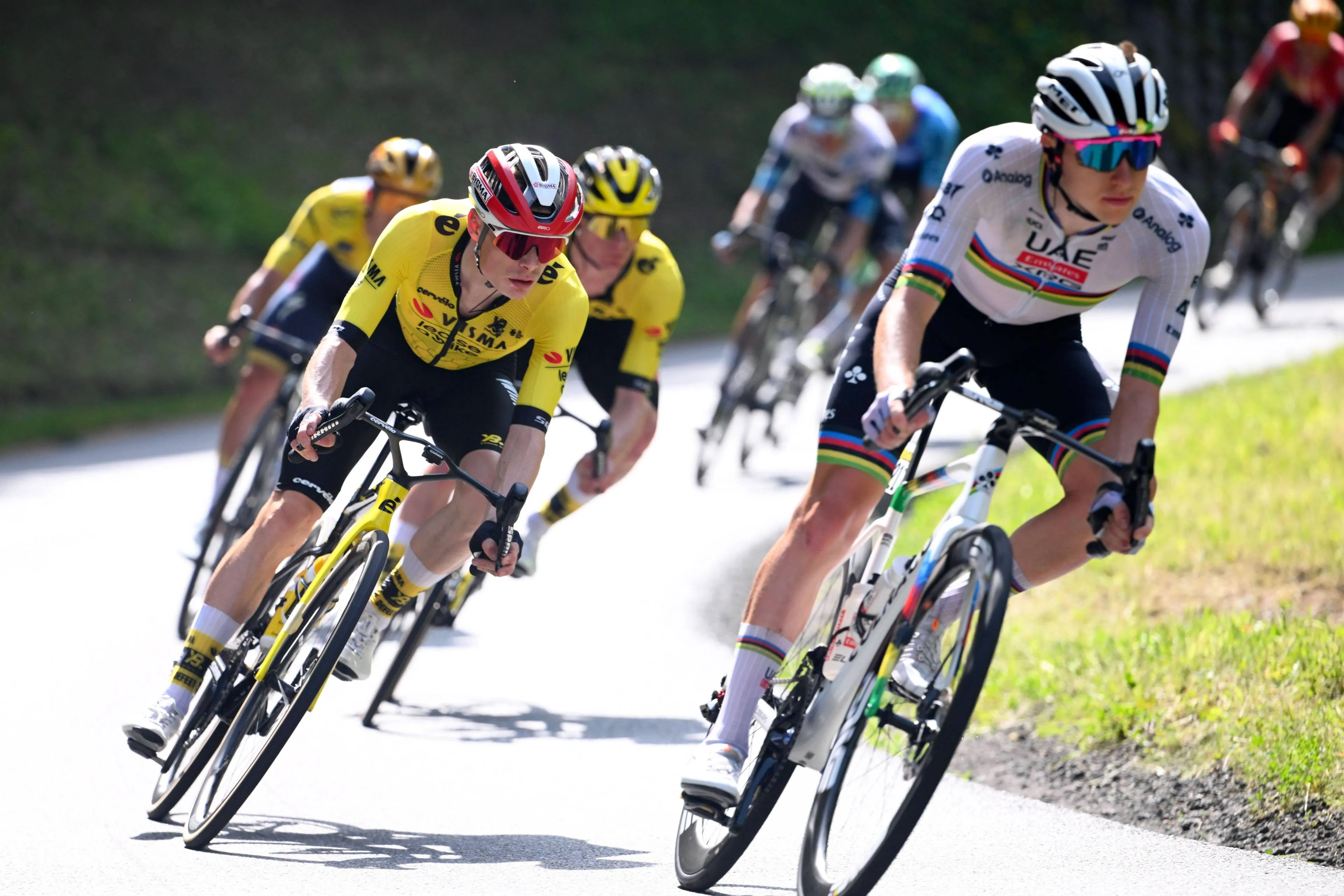
The first head-to-head of the 2025 season between cycling’s modern giants — Jonas Vingegaard and Tadej Pogacar — has reignited anticipation for what promises to be a seismic Tour de France. Their battle at the Critérium du Dauphiné was a tactical and physical skirmish that offered more than just a podium; it delivered critical insight into what lies ahead in July.
Though Pogacar claimed victory, the performance of Vingegaard, who had not raced since Paris–Nice, turned heads. On the opening stage, a searing attack with 6km to go shattered the peloton’s structure, launching a five-man selection that included Pogacar, Remco Evenepoel, Mathieu van der Poel, and Santiago Buitrago. It was a statement — Vingegaard wasn’t just building form; he was a contender from the gun.
By the time the individual time trial wrapped Stage 4, Vingegaard found himself in yellow, demonstrating that his legs were already dialled in. The final verdict on GC saw Pogacar win the Dauphiné, but the final gap of 59 seconds was anything but decisive. It suggested vulnerability — and an open door.
1. Leveling Up: Vingegaard’s Explosivity Must Rise
Where Pogacar thrives — and often hurts his rivals — is in his unmatched acceleration on steep gradients. His ability to generate and sustain power surges on summit finishes frequently catches the field flat-footed. Vingegaard, for all his diesel-engine strength, typically responds rather than dictates on such terrain.
To win this Tour, that pattern must shift. Vingegaard needs to develop the confidence and physiological edge to launch rather than chase. If he can meet Pogacar’s ferocity with his own, or better yet, pre-empt it, the narrative of mountain stages could change entirely. Whether it’s the Tourmalet or the Galibier, the Danish star must move from the passenger seat to the driver’s saddle.
2. Capitalizing on Pogacar’s Time Trial Blind Spot
Pogacar’s 2025 calendar has been nothing short of legendary: Milano–Sanremo, Tour of Flanders, Paris–Roubaix, Liège–Bastogne–Liège — he’s contested and often dominated across cycling’s hallowed grounds. But this Classics-heavy approach came at a price: a notable dip in time trial sharpness.
At the Dauphiné, that soft spot was evident. Stage 4’s ITT saw Pogacar outpaced by both Vingegaard and Evenepoel. The Slovenian admitted post-stage that time trialling had taken a back seat in his training priorities. Should that deficiency persist into July, it opens a clear tactical door.
For Vingegaard, who has honed his aero position and power output over the past two seasons, this is the domain where minutes can be taken — not just seconds. The more he can lean into his chrono advantage, the more he can reshape the Tour narrative before the decisive climbs even begin.

3. Visma’s Collective Strength vs UAE’s Star Power
Grand Tours are never won by captains alone. The supporting cast defines whether ambitions become reality. UAE Team Emirates — with Joao Almeida, Adam Yates, and Jay Vine — is potent. But question marks remain about their tactical cohesion across three weeks.
Team Visma | Lease a Bike counters with raw horsepower and strategic depth. Simon Yates, fresh off a Giro d’Italia triumph on the fearsome Colle delle Finestre; Wout van Aert, rebounding with brilliance; Sepp Kuss, the American metronome in the mountains; and Matteo Jorgenson, an all-terrain engine. On paper, it’s formidable. On the road, unity will be everything.
If Visma executes a coordinated plan — controlling tempo, protecting Vingegaard, isolating Pogacar — they can exploit UAE’s occasional tactical looseness. The Giro showed the limits of Pogacar’s team support; the Tour may magnify them.
The Yellow Jersey Still Hangs in the Balance
Despite Pogacar’s strength in the Dauphiné, Vingegaard is closer than the result suggests. The Tour de France isn’t decided on form alone — it’s shaped by timing, teamwork, and tenacity. If Vingegaard finds another gear in his accelerations, leverages every second in the time trials, and benefits from a unified team assault, we could be witnessing the return of the Maillot Jaune to Copenhagen.
July looms large — and with it, the most compelling chapter yet in this modern rivalry.