
The 2026 Tour de Romandie runs from April 28 to May 3, and it marks Tadej Pogacar‘s long-awaited return to stage-racing this year. Nestled between the spring classics and the Giro d’Italia, the Swiss race serves as the last meaningful proving ground before the first Grand Tour. Many riders are still managing their form after an intense classics campaign, but this race has a way of exposing who’s genuinely ready and who isn’t. If you’re newer to following cycling betting, our guide on how to bet on sports can help you get started.
First held in 1947 with Belgian Désiré Keteleer claiming the inaugural victory, the race through French-speaking Switzerland has always attracted an eclectic range of champions. Legends like Eddy Merckx, Bernard Hinault, Stephen Roche, and Laurent Jalabert have all stamped their authority on the race. More recently, Cadel Evans, Bradley Wiggins, and Chris Froome each used Romandie as a springboard before winning their first Tour de France. Nairo Quintana, Richie Porte, Primoz Roglic, and Geraint Thomas have all lifted the GC trophy here too, cementing Romandie’s status as one of the seven major non-Grand Tour stage races.
Prologue: Villars-sur-Glane to Villars-sur-Glane

3.1 kilometres
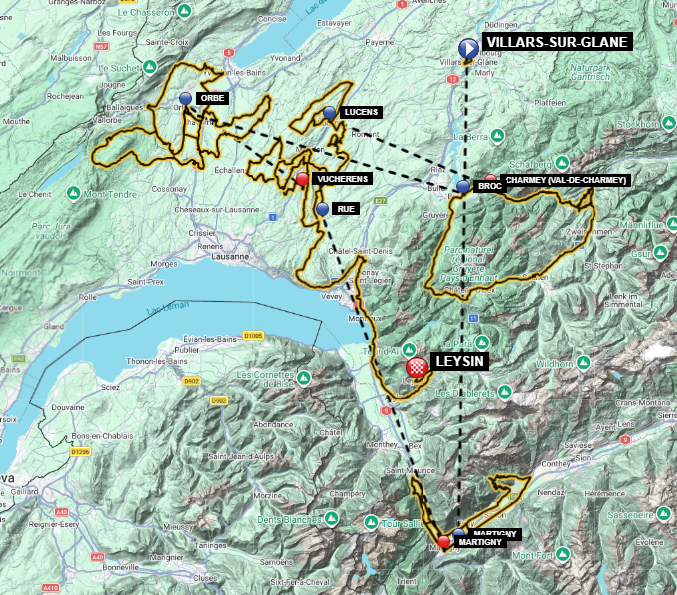
Romandie opens with a prologue, and true to the race’s character, it’s far from straightforward. Contained entirely within Villars-sur-Glane, the 3.1-kilometre effort packs a real punch despite its brevity. Riders plunge downhill immediately after the start ramp before hitting a climb that stretches 1.3 kilometres at 5%. The decisive section is an 800-metre ramp at 7% where the real gaps will open up. Raw power and aerodynamic efficiency will determine the outcome. Don’t expect big time differences, but even a handful of seconds can matter by the end of the week.
Stage 1: Martigny to Martigny

170.9 kilometres
The peloton shifts to the Rhône valley for a stage that captures the region’s geography perfectly. Wide valley roads give way to savage slopes climbing toward mountain villages scattered across the hillsides. A circuit just north of Martigny features a 2.5-kilometre climb at 8.5% tackled three times, which acts as a warm-up for what follows.
And what follows is brutal. The ascent to Ovronnaz is the hardest climb in the entire race: 8.9 kilometres at 9.8% average gradient. Riders should reach the base with relatively fresh legs, but this climb will shatter the field with its relentless gradient and switchbacks. The summit comes with 35.5 kilometres remaining. A tactical descent leads back into the flat valley floor for the finish in Martigny. We think this is where the GC battle truly begins.
Stage 2: Rue to Vucherens

173.7 kilometres
A slightly more forgiving profile than stage 1, though the 173-kilometre route from Rue to Vucherens still packs 2,700 metres of climbing that starts almost from the gun. There’s no proper mountain on the menu, but the rolling terrain is relentless. A three-lap circuit closes the stage, with the finish following a short ascent.
Classics-type riders get a chance here. A sprint finish from a reduced bunch is possible, though a breakaway could absolutely survive in these unpredictable rolling roads. The final climb is 3.1 kilometres at 5.4%, topping out just 2.5 kilometres from the line. Fatigue accumulated through the day will make this harder than it looks on paper. Attacks are likely, and honestly, an opportunistic move could stick. If nothing goes, the fast men get maybe their only shot of the whole week. For anyone unfamiliar with terms like “GC” or “peloton,” our sports betting glossary can help.
Stage 3: Orbe to Orbe

176.5 kilometres
A mountain stage, yes, but arguably the most accessible of the four. This is a day built for the baroudeurs, the breakaway hunters, regardless of whether they’re climbers, rouleurs, or classics specialists. The hilly opening kilometres should spark an explosive start and facilitate a strong group going clear. By this point in the race, the GC gaps will be large enough that most breakaway hopefuls get a free pass.
The bulk of the route is rolling without any truly fearsome ascent until the Col du Mollendruz in the final quarter: 9 kilometres at 6.7%. Difficult but not savage, with no sections that are absurdly steep. The summit comes 33 kilometres from the finish, followed by a mostly downhill run into Orbe. Only the last 10 kilometres are flat, which means an organized peloton can still reel in a breakaway if they commit. Chaos and tactical awareness could decide this one.
Stage 4: Broc to Charmey (Val-de-Charmey)

149.3 kilometres
Stage 4 is a unique mountain day with one defining feature: the riders climb the same mountain three times, each via a different route. The Jaunpass is the star. After 15 flat opening kilometres from Broc, the climbing begins. The first ascent through Jaun measures 6 kilometres at 7.8%. After descending, the peloton tackles it again via Littisback, which is 7.4 kilometres at 8.8%. Both come over 100 kilometres from the finish, giving breakaway opportunists room to maneuver.
The riders then loop back through the valley to face the Jaunpass a third time, now via Weissenbach. This is the toughest of the three ascents: 8.1 kilometres at 8.3%. The summit arrives with only 16.5 kilometres to go, and it will be treated as the decisive climb. From there, the route back to Charmey is half downhill, half false-flat, making for a fast run to the line through roads the riders will have already seen twice. Maybe a breakaway survives, maybe it doesn’t, but GC riders will be watching each other closely here.
Stage 5: Lucens to Leysin

182.6 kilometres
The final stage kicks off from Lucens with a rolling start that should trigger aggressive racing and a strong breakaway. Most of the day unfolds on hilly terrain northeast of Lausanne before the route swings south back into the Rhône Valley. The climbers then detour deep into the Alps toward the Leysin ski station, a familiar finish in this race.
The concluding ascent is a long one: 14.3 kilometres at 5.9% average, with its base in Aigle, home of the UCI headquarters. The hardest gradients come in the final third, so the real fireworks should be reserved for the closing kilometres. The race finishes at the summit. This is where the GC will be sealed.
Favourites and Predictions
This is Tadej Pogacar‘s race to lose. There’s really no other way to put it. We think that if UAE Team Emirates wanted to go all-in, he could legitimately contest every single stage. It’s reminiscent of the Itzulia scenario where the World Champion was the overwhelming favourite throughout, and the only question was whether the team would spend energy chasing every opportunity. Probably not, but it’s within his reach. Pogacar arrives with strong form, and even with a modest support cast, his rivals would need him to have a genuinely bad day on one of the queen stages to threaten his position. Please always gamble responsibly when placing any bets.
Florian Lipowitz of Red Bull – BORA – hansgrohe should be the clear second favourite. This is the race where he broke through two years ago. The climbing profiles suit him, and his form has been building steadily all spring without any classics distractions. His team brings firepower too: Primoz Roglic and Daniel Martínez headline a climber-heavy lineup capable of causing real damage, both podium candidates if they hit peak condition.
Among the other contenders, Oscar Onley leads INEOS Grenadiers, while Bahrain – Victorious bring Lenny Martínez, though the form of Antonio Tiberi and Damiano Caruso remains uncertain. The startlist is almost exclusively climbers since most stages are mountainous, and it’s a compact field of just 15 teams and slightly over 100 riders. Names like Lorenzo Fortunato, Cristián Rodríguez, Pablo Castrillo, Jorgen Nordhagen, Luke Plapp, George Bennett, Georg Steinhauser, and Marco Brenner all have the talent to challenge for the overall classification. Our editorial policy ensures all predictions are made independently, and we encourage you to understand your rights as a player before wagering.
Our Tour de Romandie 2026 GC Prediction
| Tier | Riders |
|---|---|
| Top Favourite | Tadej Pogacar |
| Strong Contenders | Florian Lipowitz, Lenny Martínez, Oscar Onley |
| Podium Threats | Antonio Tiberi, Primoz Roglic, Daniel Martínez, Lorenzo Fortunato, Pablo Castrillo, Jorgen Nordhagen, Luke Plapp, Georg Steinhauser |
Our Pick: Tadej Pogacar