
| Prefer us on Google — see Tips.gg in Top Stories & Discover | Add on Google |
The 2026 Vuelta a España runs from Saturday, August 22 to Sunday, September 13, and the route ASO and Unipublic have drawn up is anything but a gentle wind-down to the season. Four countries, 3,275km, 58,156 metres of climbing and a finale that saves the hardest climb of the entire race for the second-to-last day. The 81st edition starts in Monaco and ends in Granada, and between those two points sit six mountain stages, two individual time trials and a Grand Tour first that puts the Principality in the record books.
Vuelta a España 2026 at a Glance: Dates, Distance and Key Numbers
- Dates: Saturday, August 22 – Sunday, September 13, 2026
- Edition: 81st
- Grand Départ: Monaco
- Finish: Granada
- Countries: Monaco, France, Andorra, Spain
- Total distance: 3,275km across 21 stages
- Total elevation gain: 58,156m
- Rest days: Monday, August 31 and Monday, September 7
- Status: Third and final Grand Tour of the 2026 season, race 31 of 36 on the UCI WorldTour calendar
For context, the previous edition — won by Jonas Vingegaard — covered 3,166.8km. The 2026 route is longer, and considerably lumpier.
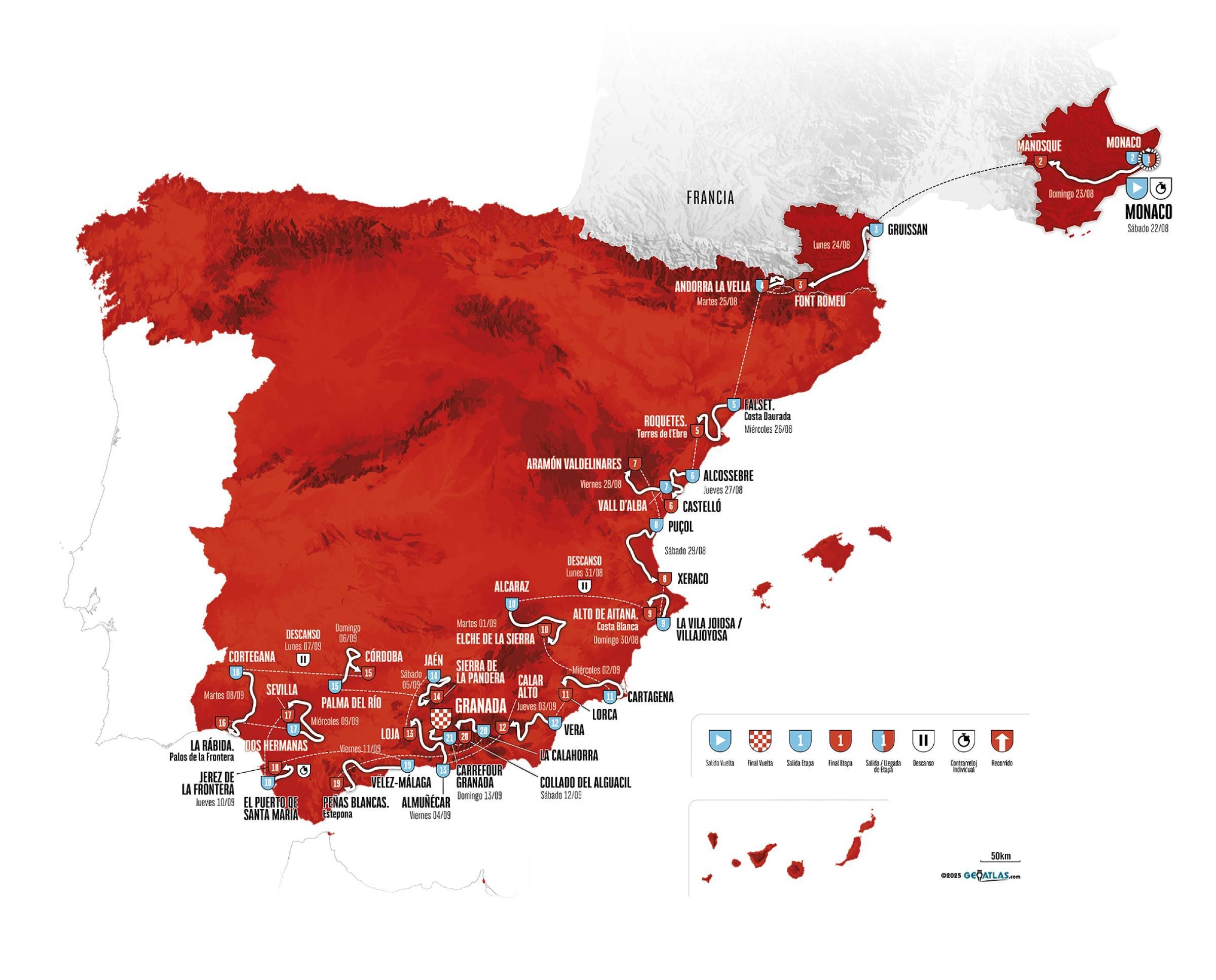
lavuelta.es
Full Vuelta a España 2026 Schedule: Every Stage, Date and Distance
| Stage | Date | Start – Finish | Distance | Elevation | Profile |
|---|---|---|---|---|---|
| 1 | Sat, Aug 22 | Monaco – Monaco | 9km | 224m | Individual time trial |
| 2 | Sun, Aug 23 | Monaco – Manosque | 215.2km | 3,110m | Hilly |
| 3 | Mon, Aug 24 | Gruissan – Font Romeu | 166.7km | 2,596m | Medium mountains |
| 4 | Tue, Aug 25 | Andorra la Vella – Andorra la Vella | 104.9km | 3,009m | Mountain |
| 5 | Wed, Aug 26 | Falset – Roquetes | 171.1km | 1,659m | Hilly |
| 6 | Thu, Aug 27 | Alcossebre – Castelló | 176.8km | 3,045m | Medium mountains |
| 7 | Fri, Aug 28 | Vall d’Alba – Aramón Valdelinares | 149.9km | 3,572m | Mountain |
| 8 | Sat, Aug 29 | Puçol – Xeraco | 176.4km | 1,305m | Flat |
| 9 | Sun, Aug 30 | La Vila Joiosa – Alto de Aitana | 187.5km | 5,048m | Mountain |
| — | Mon, Aug 31 | Rest day | — | — | — |
| 10 | Tue, Sep 1 | Alcaraz – Elche de la Sierra | 184.5km | 2,670m | Hilly |
| 11 | Wed, Sep 2 | Cartagena – Lorca | 156.1km | 1,391m | Flat |
| 12 | Thu, Sep 3 | Vera – Calar Alto | 166.5km | 4,460m | Mountain |
| 13 | Fri, Sep 4 | Almuñécar – Loja | 193.2km | 3,399m | Medium mountains |
| 14 | Sat, Sep 5 | Jaén – Sierra de la Pandera | 152.7km | 4,060m | Mountain |
| 15 | Sun, Sep 6 | Palma del Río – Córdoba | 181.2km | 2,853m | Medium mountains |
| — | Mon, Sep 7 | Rest day | — | — | — |
| 16 | Tue, Sep 8 | Cortegana – La Rábida | 186km | 2,244m | Hilly |
| 17 | Wed, Sep 9 | Dos Hermanas – Sevilla | 189.2km | 956m | Flat |
| 18 | Thu, Sep 10 | El Puerto de Santa María – Jerez de la Frontera | 32.5km | 178m | Individual time trial |
| 19 | Fri, Sep 11 | Vélez-Málaga – Peñas Blancas | 205.1km | 3,987m | Hilly, uphill finish |
| 20 | Sat, Sep 12 | La Calahorra – Collado del Alguacil | 187km | 5,041m | Mountain |
| 21 | Sun, Sep 13 | Carrefour Granada – Granada | 99.4km | 1,193m | Flat |
Only stages 2 and 19 break the 200km barrier, which tells you where this route does its damage: not with brute length, but with gradient.
Vuelta a España 2026 Stage Types: Where the Race Gets Decided
- 6 mountain stages — stages 4, 7, 9, 12, 14 and 20
- 4 medium-mountain stages — stages 3, 6, 13 and 15
- 4 hilly stages — stages 2, 5, 10 and 16
- 1 hilly stage with an uphill finish — stage 19 to Peñas Blancas
- 4 flat stages — stages 8, 11, 17 and 21
- 2 individual time trials — stages 1 and 18, 41km against the clock in total
Ten summit-heavy days against four genuinely flat ones. The sprinters who commit three weeks to this race will be fighting over scraps, and the ones who survive to Granada will find the final stage has been booby-trapped as well.
Why the Monaco Grand Départ Makes Vuelta History
For the third consecutive edition — and only the seventh time in the race’s history — the Vuelta rolls out from foreign soil. Monaco takes the honour 17 years after staging the Grand Départ of the 2009 Tour de France, and having hosted the start of the Giro d’Italia back in 1966, the Principality becomes the first city on earth to have launched stage 1 of all three Grand Tours.
Vuelta 2026 Week 1: From the Monaco Time Trial to the Alto de Aitana
Stages 1–3: A Race Against the Clock, Then Font Romeu
Stage 1 | Monaco – Monaco, 9km ITT. The route starts beside the Monte Carlo Casino, throws a few lumpy kilometres at the riders and then flattens into a technical dash through the Principality’s streets. Small gaps, first red jersey.
Stage 2 | Monaco – Manosque, 215.2km. The longest stage of the race drops towards Nice before rolling across southern France. Two category 3 climbs come too early to matter; the uphill drag to the line favours a hardened fast finisher.
Stage 3 | Gruissan – Font Romeu, 166.7km. Flat for 100km, then the category 1 Col de Mont-Louis crests with 15km left before the run up to Font Romeu at 1,800m. Gruissan last hosted a Vuelta finish in 2017, when Yves Lampaert ambushed the sprinters in the wind.
Stages 4–6: Andorra’s Ambush and Two Sprint Chances
Stage 4 | Andorra la Vella – Andorra la Vella, 104.9km. Only 104.9km, but 3,009m of climbing and the first Vuelta stage ever to start and finish in Andorra la Vella. The category 1 Collada de Beixalis and Coll d’Ordino come back-to-back with 25km left, and with Tadej Pogačar on the start list this is where the GC could crack inside four days.
Stage 5 | Falset – Roquetes, 171.1km. Billed as hilly but built for a bunch kick, with the category 3 Alto de Paüls topping out over 20km from a first-time Vuelta finish town.
Stage 6 | Alcossebre – Castelló, 176.8km. A medium-mountain day with 3,045m of climbing — enough vertical to hand a strong breakaway the initiative rather than the sprinters.
Stages 7–9: Valdelinares and the Aitana Sting
Stage 7 | Vall d’Alba – Aramón Valdelinares, 149.9km. Short, sharp and stacked with 3,572m of climbing to a genuine summit finish. The first day the overall favourites can’t hide on Spanish roads.
Stage 8 | Puçol – Xeraco, 176.4km. The first flat road stage, with one catch: the category 2 Puerto de Barx crests 22km out, and anyone dropped there won’t see the sprint.
Stage 9 | La Vila Joiosa – Alto de Aitana, 187.5km. Six categorised climbs, 5,048m of climbing and almost no flat road. The category 1 Alto de Aitana returns on the 25th anniversary of its Vuelta debut, and route designer Fernando Escartín has flagged the heat as an extra opponent. In 2016, Pierre Latour won here while Nairo Quintana held off Chris Froome for red.
Vuelta 2026 Week 2: Calar Alto, La Pandera and Andalusian Heat
Stages 10–12: Lorca Sprint and the Calar Alto Showdown
Stage 10 | Alcaraz – Elche de la Sierra, 184.5km. Three categorised climbs, constant rolling terrain and an uphill final kilometre — a breakaway day unless the sprinters’ teams commit early.
Stage 11 | Cartagena – Lorca, 156.1km. A cleaner sprint chance, with only the category 3 Alto del Morrón in the way, 33.5km from the line. Tyler Farrar was the last man to win a Vuelta sprint in Lorca, back in 2010.
Stage 12 | Vera – Calar Alto, 166.5km. Five climbs and 4,460m of climbing, closing with the classic one-two of the category 1 Alto de Velefique — summiting 31km out — and the finish at Calar Alto, above 2,100m. Miguel Ángel López won here in 2017.
Stages 13–15: Sierra de la Pandera and the Córdoba Breakaway Day
Stage 13 | Almuñécar – Loja, 193.2km. The category 1 Puerto Los Guájares comes 160km from the line, and after the category 2 Puerto de Granada there are 32km of flat road — enough for a versatile fast finisher to get back on terms.
Stage 14 | Jaén – Sierra de la Pandera, 152.7km. Rolling all day, then the Sierra de la Pandera, a savage climb that has appeared six times since its 2002 debut and never produced a quiet finish. Richard Carapaz won here in 2022; the southern heat will again be a factor.
Stage 15 | Palma del Río – Córdoba, 181.2km. Three category 3 climbs, plenty of uncategorised lumps and a flat run-in from the Puerto Artafi, just under 30km out. Wout van Aert was the last winner in Córdoba.
Vuelta 2026 Week 3: Sevilla, Jerez and the Alguacil Showdown
Stages 16–18: Sprint Chances and the Time Trial That Reshuffles the GC
Stage 16 | Cortegana – La Rábida, 186km. Rolling early, no categorised climbs and a flat, fast coastal finale — though sea wind could still cause chaos.
Stage 17 | Dos Hermanas – Sevilla, 189.2km. The flattest stage of the race and realistically the last clean sprint. It will be the sixteenth Vuelta finish in Seville’s streets, two years after Pavel Bittner beat van Aert there.
Stage 18 | El Puerto de Santa María – Jerez de la Frontera, 32.5km ITT. Of the 41km of time trialling in this route, 32.5km land here, deep in week three. The flat coastal course along the Bay of Cádiz suits the powerhouses and exposes lightweight climbers to the wind. Jerez has staged twelve Vuelta finishes, seven of them time trials.
Stages 19–21: Peñas Blancas, the Alguacil and the Alhambra Finale
Stage 19 | Vélez-Málaga – Peñas Blancas, 205.1km. The second-longest stage, flat for 70km before three categorised climbs and a category 1 uphill finish. Richard Carapaz soloed to victory here in 2022. Red probably isn’t won on this stage — but it can be lost.
Stage 20 | La Calahorra – Collado del Alguacil, 187km. The queen stage: 5,041m of climbing, five ascents, escalating all day through the Puerto de El Purche twice and a first-ever Vuelta climb of the Puerto de El Duque. Then the Collado del Alguacil, the race’s only Categoría Especial climb — 8.3km at 9.8%, near-double-digit gradients throughout. Chris Horner won on the Hazallanas climb here in 2013 en route to his shock overall title.
Stage 21 | Carrefour Granada – Granada, 99.4km. No procession. The closing city circuit features five ascents of the climb to the Alhambra, the last of them finishing at the line — a launchpad for attacks that leaves either a solo winner or an explosive uphill sprint, with the GC live to the final kilometre.
Riders to Watch at the Vuelta a España 2026
The provisional line-ups already read like a heavyweight bout. UAE Team Emirates – XRG bring Tadej Pogačar alongside Jay Vine, Red Bull – BORA – hansgrohe list Primož Roglič and Laurence Pithie, and Team Visma | Lease a Bike pair Wout van Aert with Matthew Brennan. EF Education – EasyPost have Richard Carapaz, a proven winner on both Peñas Blancas and Sierra de la Pandera, while Movistar field Cian Uijtdebroeks and Iván Romeo on home roads.
Add Mads Pedersen and Mattias Skjelmose at Lidl-Trek, Oscar Onley at Netcompany INEOS and Santiago Buitrago at Bahrain-Victorious, and there is depth for every terrain this route throws up. With a 32.5km time trial in week three and a Categoría Especial summit on the penultimate day, the pre-race markets will be volatile — for a closer look at the outright odds and stage-by-stage predictions as the start list firms up, Tips.gg has the analysis covered.
Vuelta a España 2026 FAQ
When does the Vuelta a España 2026 start and finish?
The race runs from Saturday, August 22 to Sunday, September 13, 2026, across 21 stages.
Where does the 2026 Vuelta start?
In Monaco, with a 9km individual time trial. It makes Monaco the first city to have hosted the opening stage of all three Grand Tours.
Where does the 2026 Vuelta finish?
In Granada, on a city circuit featuring five ascents of the climb to the Alhambra, with the final ascent finishing at the line.
How long is the Vuelta a España 2026?
3,275km in total, with 58,156m of elevation gain.
Which countries does the route cover?
Monaco, France, Andorra and Spain.
When are the rest days?
Monday, August 31 and Monday, September 7.
What is the hardest stage of the 2026 Vuelta?
Stage 20 to the Collado del Alguacil — 187km, 5,041m of climbing, and the race’s only Categoría Especial climb at 8.3km averaging 9.8%.
How many time trials are there?
Two, totalling 41km: the 9km opener in Monaco and a 32.5km test from El Puerto de Santa María to Jerez de la Frontera on stage 18.
A Vuelta Built for a Late Twist
What makes this route compelling isn’t the raw numbers — it’s the sequencing. The Andorran ambush on stage 4 means the GC can crack before the first weekend is out. The Jerez time trial arrives late enough to punish a climber who has been living on the edge. And the Collado del Alguacil sits on the penultimate day, guaranteeing that nobody can defend a slim lead with a calculator. As the closing Grand Tour of the 2026 season, with Pogačar, Roglič and Carapaz all pencilled in, the Vuelta has handed itself the perfect stage for a September showdown — and a finish in Granada that refuses to be a formality.