
You’ve probably seen the bragging: “70% accurate picks this month!” or “Crushing it with 68% win rate on favorites.” It looks impressive. It feels good. But here’s the brutal truth most punters ignore: high accuracy rarely equals profit in sports betting.
In fact, thousands of bettors consistently hit 65–70% winners on short-priced favorites (odds 1.30–1.50) … and still bleed money month after month. Why? Because winning frequency and actual profitability are two completely different games.
The real question isn’t “How often do I win?”
It’s “How much do I make when I win – and how much do I lose when I don’t?”
This is the accuracy/ROI paradox – one of the biggest money traps in betting. Bettors chasing shiny win-rate stats often end up as long-term losers, while pros with “only” 45–50% accuracy quietly build bankrolls.
Let’s break it down step by step – and show you why focusing on value and ROI beats obsessing over being right every time.
What Betting Accuracy Actually Measures
Accuracy – often called win rate – simply shows how many bets win compared to the total number placed.
For example:
- 60 wins from 100 bets = 60% accuracy
At first glance, that sounds excellent. In most competitive environments, a 60% success rate would signal strong performance. In sports betting, however, accuracy alone ignores one critical factor: odds.
A bettor could achieve a 70% win rate while consistently betting on heavy favorites with odds around 1.30 – and still lose money over time. This happens because the reward for winning is too small compared to the risk taken when bets lose.
This is where the accuracy/ROI paradox begins:
- Accuracy measures how often you win.
- ROI measures how much you earn from what you risk.
Only one of those reflects real profitability.
The Odds Factor: Why A 60% Win Rate Can Still Lose Money
Let’s look at a simple example.
Imagine placing 100 bets with odds of 1.30 and staking $100 per bet while maintaining a 60% win rate.
Each winning bet generates:
Profit = Stake × (Odds − 1)
Profit = $100 × 0.30 = $30
Total profit from wins:
60 wins × $30 = $1,800
Total losses:
40 losing bets × $100 = $4,000
Final result:
Net loss = −$2,200
ROI = −22%
Despite winning the majority of bets, the bettor loses money because the odds do not compensate for losses when they occur.
This is one of the most common traps in sports betting, especially among beginners who instinctively gravitate toward short-priced favorites.
Real-World Scenario: Two Bettors, Two Approaches
To better understand how accuracy and profitability diverge, consider two hypothetical bettors over a full season.
| Metric | Bettor A: The Favorite Hunter | Bettor B: The Value Seeker |
|---|---|---|
| Average Odds | 1.35 | 2.40 |
| Win Rate | 68% | 46% |
| Strategy | Betting mainly on strong favorites in top European leagues | Targeting underdogs or mispriced markets in secondary leagues |
| Expected Long-Term Yield/ROI | Negative to low (often -5% to +2% due to low value on favorites) | Positive (potentially +8% to +20%+ if consistent +EV) |
| Profit Focus | High win frequency | High value per bet |
Even though Bettor A wins significantly more bets, Bettor B can easily produce higher long-term ROI if their selections consistently offer better value relative to real probabilities.
Professional bettors rarely aim to maximize win rate. Instead, they aim to maximize expected profit per bet.
What Truly Drives Profit: Expected Value (+EV)
Profitability in sports betting revolves around expected value (+EV). A bet has positive expected value when the odds offered by bookmakers are higher than the true probability of the event occurring.
The simplified formula looks like this:
Positive EV exists when:
Real Probability × Odds > 1
For example:
- True probability of outcome: 50% (0.50)
- Bookmaker odds: 2.20
0.50 × 2.20 = 1.10 → Positive expected value
This means that, over time, repeatedly taking similar opportunities should generate profit, even if many individual bets lose.
This is why professional bettors focus on identifying mispriced markets rather than chasing high accuracy percentages.

Source: canva.com
How Bettors Can Apply Value Thinking
Understanding value is important, but applying it is what separates theory from real betting success. Here are practical steps bettors can follow:
1. Learn To Read Implied Probability
Bookmaker odds always reflect an implied probability.
Example:
- Odds 2.00 → 50% implied probability
- Odds 1.50 → 66.7% implied probability
Comparing implied probability with your own estimation is the foundation of value betting.
-
Track Closing Line Value (CLV)
Closing odds – the final odds before an event starts – are widely considered one of the strongest indicators of betting skill.
If your bets consistently beat the closing line, it usually suggests you are finding value before the market adjusts.
-
Use Large Sample Sizes
Profitability cannot be judged over 10 or 20 bets. Variance in sports betting is significant. Meaningful evaluation usually requires hundreds of bets.
-
Combine Value With Bankroll Management
Even profitable bettors experience losing streaks. Using flat staking or percentage-based staking protects capital and stabilizes long-term ROI.
Why Tip Accuracy Alone Often Misleads Bettors
Many prediction services promote impressive win rates such as “65% successful picks.” While these figures sound convincing, they rarely provide full context.
Common missing elements include:
- Odds weighting
- Long-term ROI tracking
- Market movement analysis
- Expected value measurement
Without these factors, win rate becomes a vanity metric rather than a meaningful performance indicator.
A service may appear successful simply because it focuses heavily on low-risk, low-reward selections.
A More Data-Driven Approach To Betting Signals
Modern betting analysis is moving away from just subjective prediction and toward using statistical modeling and big data aggregation.
Some analytical platforms try to find betting possibilities by looking at past performance, group predictions, and bookmaker prices. These algorithms try to show when the odds in the market can be lower than the real chances of anything happening.
Value-focused firms like Tips.gg Premium, for example, look at thousands of forecasts and compare them to bookmaker markets to find possible +EV opportunities. These kinds of systems don’t focus on raw accuracy; instead, they try to show when statistical consensus and market pricing are very different.
The main concept behind these models is not to pick assured wins, but to help bettors find statistically good bets before the odds change.
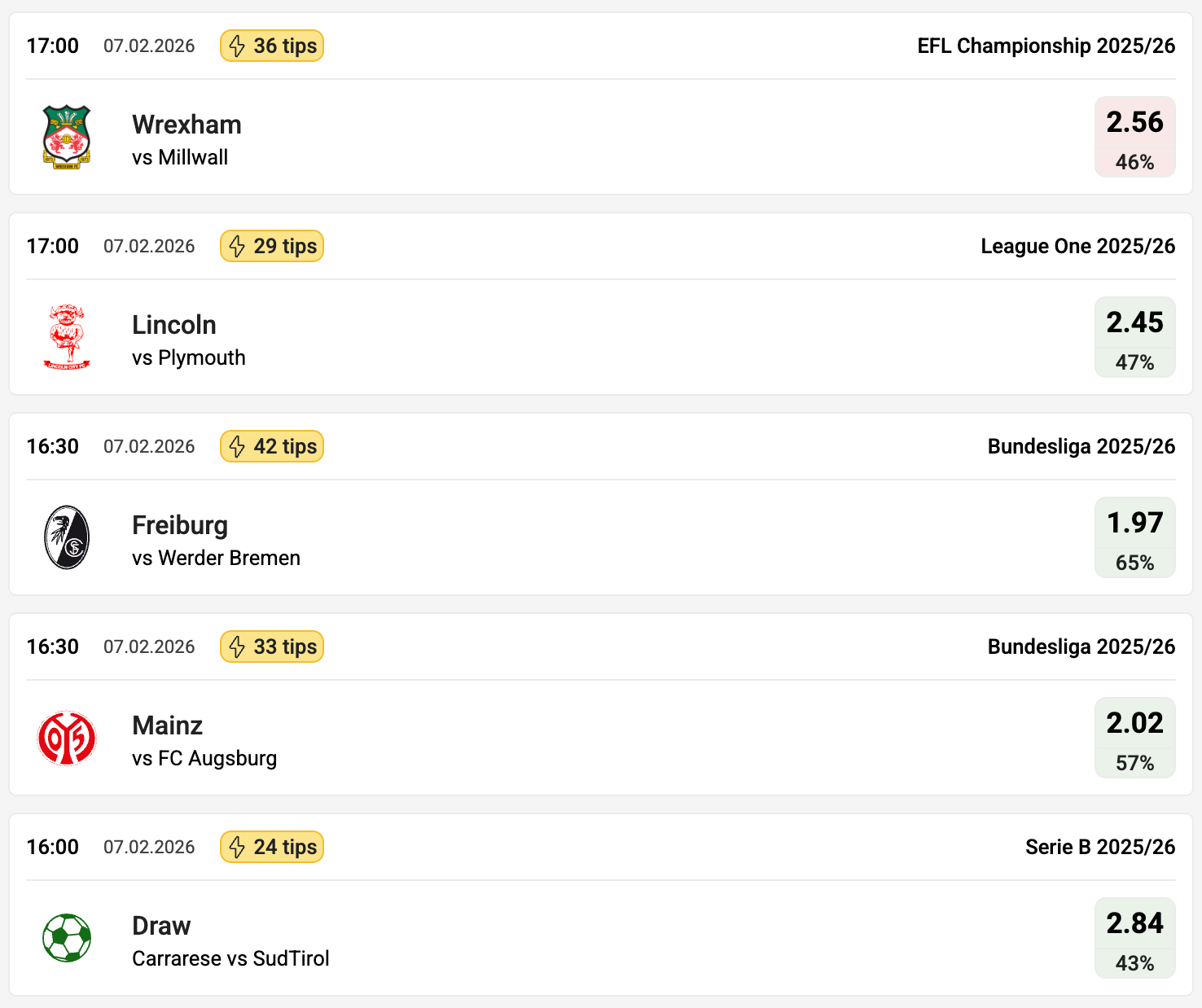
TipsGG Premium
The Role Accuracy Still Plays – In Context
Accuracy is not irrelevant. It becomes useful once value has already been established.
For example:
- Multiple independent signals agreeing on a value outcome can increase confidence.
- Higher accuracy can indicate model stability.
However, accuracy should support value-based decisions – not replace them.
Consider the comparison:
- A 45% probability outcome at odds of 2.50 can produce long-term profit.
- A 75% probability favorite at 1.83 odds may offer little or no value.
Profitability depends on the relationship between probability and price, not simply on how often a prediction wins.
Market Correction And Timing
The betting markets change all the time. Bookmakers change the odds all the time to balance risk and respond to new money flowing in.
People who just look at publicly available accuracy statistics often look at markets after changes have already been made. At that point, the possible value may already be gone.
Data-driven analysis and early signal identification try to find good chances to make money before the markets fully correct. This timing factor is one of the reasons why experienced bettors pay so much attention to price movement and consensus tendencies.
Good Betting Is Not About Being Right – It’s About Being Profitable
One of the hardest psychological adjustments for bettors is accepting that losing bets can still represent good decisions if they were placed with positive expected value.
In sports betting:
- Accuracy creates appealing statistics.
- ROI determines long-term success.
Services or strategies focused purely on prediction correctness without considering odds, probability, and value often struggle to generate sustainable profits.
Value-oriented analytical models attempt to address this gap by prioritizing mathematical edges instead of headline success rates.
Final Takeaway
Sports betting shares many similarities with financial investing. Investors do not buy assets simply because analysts predict growth. They invest when they believe an asset is undervalued relative to its true worth.
Successful bettors follow the same logic. They search for markets where bookmaker odds fail to accurately reflect real probabilities.
Accuracy can make results look impressive. ROI determines whether a betting strategy actually works.
Understanding the difference between the two shifts betting from emotional decision-making toward disciplined, data-driven strategy. And in the long run, profitability almost always belongs to bettors who prioritize value over simply being right.