
Portugal arrive at the 2026 World Cup ranked 5th in the FIFA standings and carrying the kind of depth that most national teams spend decades trying to build. The Seleção das Quinas are not just Cristiano Ronaldo’s farewell tour — though that storyline will dominate the coverage. They are a squad that went to the Azteca without their all-time top scorer and drew 0–0 with Mexico, then travelled to Atlanta three days later and dismantled the United States 2–0. Roberto Martínez used 11 substitutions across both matches and still controlled every minute of both games. The depth is real.

100% 1st Deposit Bonus up to €750 + 100 FS — FIFA World Cup 2026 on TipsGG × Casino Prestige
Follow every match of the FIFA World Cup 2026, analyze live, and place bets on the best terms. Get a 100% bonus up to €750 + 100 FS on Casino Prestige and don’t miss the chance to boost your bankroll for the biggest tournament of the year.
That Nations League title won in the summer of 2025, beating Spain in the final, was the competitive proof of concept this squad needed. It confirmed that Martínez has found both a system and a depth chart capable of functioning at the highest level regardless of which XI takes the field.
In Group K, Portugal face DR Congo, Uzbekistan, and Colombia. On paper, two comfortable wins and a decisive test in the final group match. In reality, the Colombia fixture on June 28 is the kind of high-stakes encounter where a tournament identity gets established — and where the squad management decisions made in the first two matches will matter enormously.
Portugal World Cup History: Results, Stats & Past Performances
Portugal’s World Cup history is defined by two peaks separated by decades of near-misses. Their finest hour came at the 1966 World Cup in England, where Eusébio led them to a third-place finish that remains one of the tournament’s most celebrated performances. Forty years later, Luís Figo and a golden generation reached the semi-finals again in Germany in 2006 before losing to the hosts, finishing fourth.
Between and around those milestones, consistency has been elusive. Portugal have appeared in eight World Cups — 1966, 1986, 2002, 2006, 2010, 2014, 2018, and 2022 — and have failed to advance beyond the Round of 16 more often than not. The 2022 tournament in Qatar was a reminder of both their potential and their fragility: a 6–1 thrashing of Switzerland announced them as genuine contenders, before a quarter-final exit against Morocco — on the same night Ronaldo was controversially benched — left questions about the team’s direction that Martínez has spent three years answering.
Their group-stage record is strong. In four of the past five World Cups, Portugal have advanced from the group, and their 2022 campaign in particular showed the attacking firepower available when the squad is functioning correctly. The benchmark for this team, however, has to be reaching at least the semi-finals — anything less, given the talent available, would represent underachievement.
How Portugal Qualified for the 2026 World Cup: Results & Recent Form
Portugal qualified by winning UEFA Group F, securing a direct berth as one of Europe’s group winners. The campaign was dominant in its headline numbers — 20 goals scored, including a 9–1 demolition of Armenia in the final qualifier that featured hat-tricks from both Bruno Fernandes and João Neves — but not without turbulence. A defeat to the Republic of Ireland exposed midfield vulnerabilities, and a Ronaldo red card added unnecessary noise to a campaign that should have been serene.
The underlying picture, though, is of a team that has found its structure. Under Martínez, Portugal have averaged over 70% possession across qualifying matches and won four of six fixtures. The Armenia result was a statement of attacking intent: this is not a team content to qualify quietly.
Form heading into the tournament was confirmed by the March window. Without Ronaldo — who had suffered a hamstring strain playing for Al-Nassr in late February and missed the camp entirely — Portugal controlled Mexico for 90 minutes, hit the post through Gonçalo Ramos, and left without a goal they deserved. Three days later, Francisco Trincão opened the scoring with a backheel after a Bruno Fernandes assist, before João Félix came off the bench to strike a sumptuous half-volley from the corner of the box and seal a 2–0 win over the United States. The squad depth is not a talking point. It is a fact.
Portugal Squad for the 2026 World Cup: Key Players, Lineup & Team News
Portugal possess arguably the most complete attacking depth chart at this tournament, with players competing for wide and support roles that would be considered first-choice at almost any other national team.
Expected formation: 4-2-3-1 or 4-3-3
Portugal squad at the 2026 FIFA World Cup
- Goalkeepers: Diogo Costa (Porto), José Sá (Wolverhampton), Rui Silva (Sporting CP)
- Defenders: João Cancelo (Barcelona), Diogo Dalot (Manchester United), Rúben Dias (Manchester City), Gonçalo Inácio (Sporting CP), Nuno Mendes (Paris Saint-Germain), Matheus Nunes (Manchester City), Nélson Semedo (Fenerbahçe), Tomás Araújo (Benfica), Renato Veiga (Villarreal)
- Midfielders: Bernardo Silva (Manchester City), Samú Costa (Mallorca), Bruno Fernandes (Manchester United), João Neves (Paris Saint-Germain), Rúben Neves (Al-Hilal), Vitinha (Paris Saint-Germain)
- Forwards: Francisco Conceição (Juventus), João Félix (Al-Nassr), Gonçalo Guedes (Real Sociedad), Rafael Leão (Milan), Pedro Neto (Chelsea), Gonçalo Ramos (Paris Saint-Germain), Cristiano Ronaldo (Al-Nassr), Francisco Trincão (Sporting CP)
Key Players:
Cristiano Ronaldo (41, Al-Nassr, ST) — Portugal’s all-time leading scorer with 143 international goals across 226 caps. At 41 by the time the tournament concludes, this will almost certainly be his final World Cup. A hamstring injury disrupted his March preparation, but if fit he starts, and the defensive attention he commands remains a genuine tactical factor regardless of his current output.
Bruno Fernandes (Manchester United, AM) — The most important attacking player in this squad, irrespective of what Ronaldo does. Against the United States in March he set up both goals, controlled the first-half tempo, and demonstrated again why Martínez has built the system around his movement in the half-spaces. His delivery from set-pieces, direct free kicks, and backheel creativity make him Portugal’s most complete offensive force.
Vitinha (Paris Saint-Germain, CM) — A Champions Ligue winner with PSG and a player who has earned multiple Team of the Season recognitions in France. His third-place finish in this year’s Ballon d’Or voting reflects a rise to genuine elite status. In Portugal’s midfield he provides the technical quality and positional discipline that allows Fernandes to operate freely further forward.
Rafael Leão (AC Milan, LW) — The speed and directness threat on the left. At a World Cup where defensive lines open in transition, Leão’s ability to beat full-backs in a straight line and finish from range makes him a match-winner capable of changing a game in 15 minutes of explosive football.
Rúben Dias (Manchester City, CB) — At 28, at the peak of his powers. His reading of the game, aerial authority, and ability to organise those around him makes him Portugal’s defensive cornerstone and one of the best centre-backs at this tournament.
Gonçalo Ramos (Paris Saint-Germain, ST) — The first-choice striker option when Ronaldo is managed or rested. His movement, pressing intelligence, and finishing ability were confirmed as tournament-ready by the Atlanta performance against the United States.
Portugal’s most important squad characteristic is not its first XI — it is its second. João Félix, Pedro Neto, Francisco Conceição, and Francisco Trincão are all competing for wide and support roles. None of them would be considered a fringe option at any other national team in this tournament.
Portugal Coach, Tactics & Analysis for the 2026 World Cup
Roberto Martínez arrived with a track record that makes him ideally suited to managing a squad of this complexity. He led Belgium to third place at the 2018 World Cup and pushed them to the top of the FIFA world rankings for an extended period — no small achievement with a multi-generational transition happening beneath the surface. Before Belgium, he won the 2013 FA Cup with Wigan Athletic, a result that remains one of the most remarkable upsets in English football history.
With Portugal, his preferred structure is a 4-2-3-1 or 4-3-3 depending on the opponent. Diogo Costa in goal, Rúben Dias and Gonçalo Inácio in central defence, Nuno Mendes on the left and João Cancelo or Diogo Dalot on the right, with a midfield of Vitinha and João Neves sitting deep and Bruno Fernandes operating in the ten role ahead of them. Ronaldo or Ramos leads the line, with Rafael Leão and Bernardo Silva providing width and creativity.
Against weaker opposition, Portugal dominate possession and use their width to overload defensive structures. Against stronger sides, the question is whether the creative midfield of Fernandes, Neves, and Vitinha — technically brilliant but not primarily built for ball-winning — can handle sustained high-intensity pressing without the defensive shape breaking down. That vulnerability cost Portugal in both Euro 2024 and Qatar 2022, and it remains the primary tactical concern heading into this tournament.
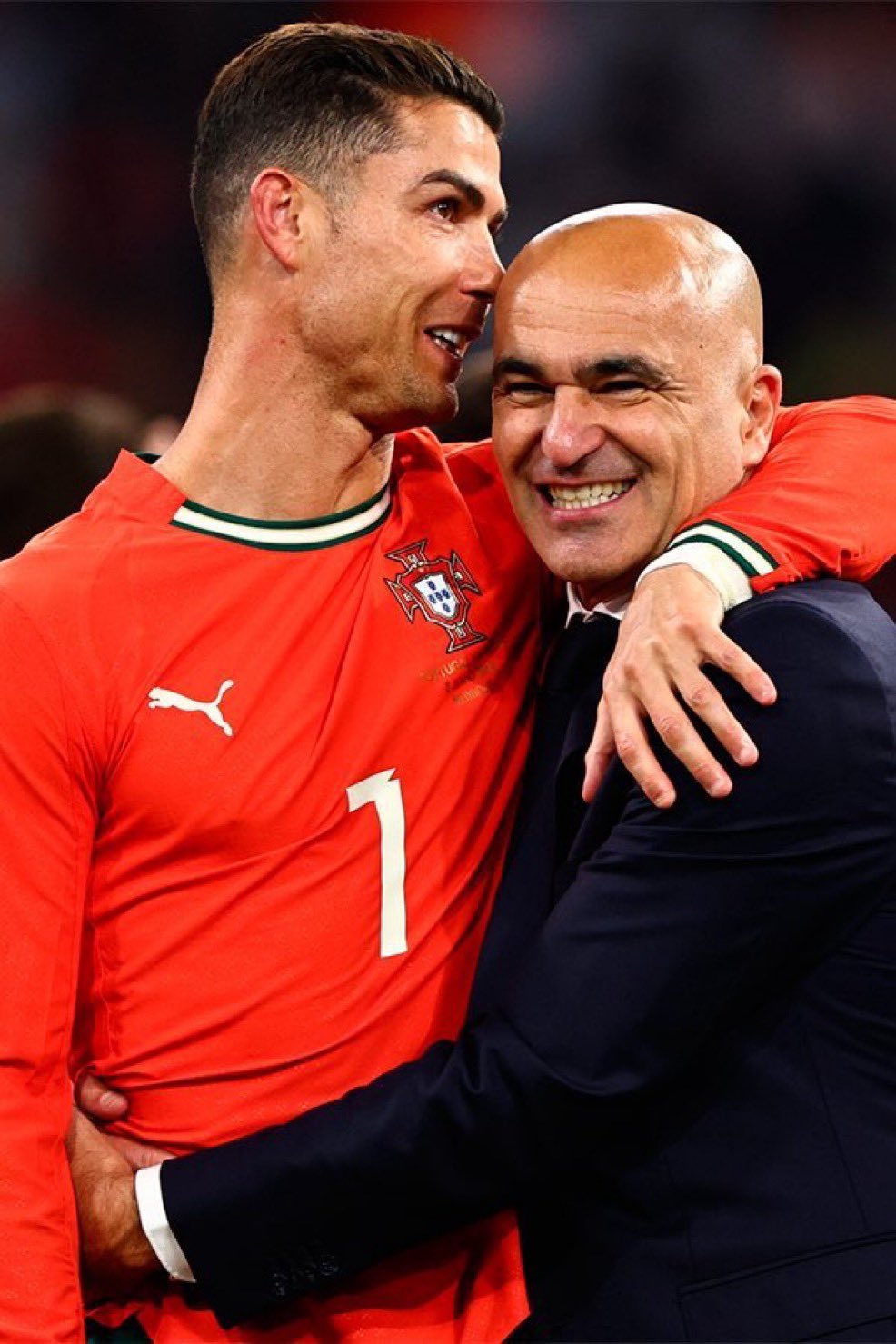
The key management decision is Ronaldo: not sentimental, but tactical. If Martínez starts him in all three group matches regardless of form or fitness, the squad management consequences could become visible in the knockout rounds when fresher attacking options become critical.
Source: x.com/NassrXtra1
Portugal Fixtures (Match Schedule) at 2026 World Cup
Portugal are placed in Group K alongside Colombia (FIFA #13), DR Congo (#46), and Uzbekistan (#50). The group contains one credible threat and two sides making significant World Cup appearances — DR Congo returning after 52 years away, Uzbekistan making their debut as an independent nation.
Strengths:
Unmatched attacking depth — multiple match-winners competing for every position. Elite ball retention and possession control under Martínez. Set-piece quality through Fernandes, Ronaldo, Mendes, and Neto. Defensive leadership through Dias at the back.
Weaknesses:
Midfield ball-winning capacity remains a vulnerability against high-press opponents. Ronaldo’s fitness and management risk could expose squad chemistry in knockout rounds. Defensive exposure behind advanced full-backs when the mid-block breaks.
Group K Schedule:
Match 1: vs DR Congo — June 17, 19:00 CEST
Match 2: vs Uzbekistan — June 23, 19:00 CEST
Match 3: vs Colombia — June 28, 01:30 CEST
DR Congo open the group and represent the best opportunity to establish rhythm and goal difference early. Uzbekistan under Fabio Cannavaro, with Abdukodir Khusanov at Manchester City as their headline European name, will be organised but outclassed. Colombia is the group’s defining match — consecutive March defeats to Croatia and France raised genuine questions about Néstor Lorenzo’s squad cohesion, but Luis Díaz at Bayern Munich gives them the individual quality to punish any Portuguese defensive lapse.
Portugal Odds & Best Bets for the 2026 World Cup: Value Picks & Predictions
Outright and Group Markets
| Market | Odds | Bookmaker | Value? |
|---|---|---|---|
| To Qualify from Group | 1.45 | Sapphirebet | Safe |
| Reach Quarter-Finals | 2.30 | Sapphirebet | Yes |
| Reach Semi-Finals | 3.40 | Sapphirebet | Yes |
| Reach Final | 6.00 | Sapphirebet | Medium |
| Win the World Cup | 12.00 | Sapphirebet | Low |
Analysis
The 1.45 to qualify from Group K reflects a market correctly identifying Portugal as comfortable group-stage operators. Given the quality of DR Congo and Uzbekistan as opponents in the first two matches, this price is justified — but it offers little value on its own and functions best as an accumulator leg rather than a standalone bet.
The quarter-finals at 2.30 is where the first genuinely interesting price appears. Portugal’s likely Round of 16 opponent, based on standard group progression, would be a third-place team or a runner-up from a neighbouring group. The squad depth and tactical flexibility Martínez has at his disposal makes Portugal strong favourites in that scenario. The implied probability at 2.30 is around 43% — which feels modest for a team of this calibre reaching the last eight.
The semi-finals at 3.40 is arguably the most attractive price in the entire Portugal odds range. It implies roughly 29% probability for a team ranked 5th in the world, with the Nations League title to their name, carrying the deepest attacking squad in the tournament. If Portugal navigate the group and win a Round of 16 tie — both of which are probable rather than speculative — the semi-final price represents genuine market inefficiency. A team averaging 2+ goals per game in qualifying, with the kind of attacking rotation that allows Martínez to bring on Félix, Neto, or Trincão from the bench, should be priced shorter.
The outright winner at 12.00 is interesting but carries the standard risks associated with tournament football: knockout variability, the Ronaldo fitness question, and the vulnerability of their midfield structure against elite pressing sides. At that price it is a speculative option rather than a core recommendation.
Recommended Bets
1. Portugal to Reach the Semi-Finals — 3.40 (Value Bet)
The most compelling price in the range. Portugal’s squad depth, recent form, and tactical maturity under Martínez are all pointing toward deep tournament progression. The Nations League victory over Spain in 2025 demonstrated they can beat elite opposition in high-stakes finals. At 3.40, the market is undervaluing a team that has solved most of the structural problems that limited them in 2022.
2. Portugal to Reach Quarter-Finals — 2.30 (Safe-to-Value Bet)
The safest of the progression markets with meaningful odds attached. Portugal’s path through Group K should be straightforward, and a Round of 16 opponent is unlikely to match their attacking depth. At 2.30, this is a high-probability bet with a worthwhile return.
3. Bruno Fernandes Anytime Goalscorer or Assist in Group Stage (Match Bets)
Not a tournament market, but a match-by-match recommendation. Fernandes set up both goals against the United States in March and scored multiple times during qualification, including a hat-trick against Armenia. In three group matches against DR Congo, Uzbekistan, and Colombia, he will be Portugal’s primary attacking creator. His direct free-kick delivery and movement between the lines make him the most likely source of goals and assists throughout the group stage.
4. Portugal Win the World Cup — 12.00 (Speculative)
Worth a small stake for believers in the squad’s ceiling. If Ronaldo is fit, the emotional momentum of a farewell tournament can be a genuine factor. If he is not, Ramos, Félix, and the attacking depth around Fernandes make Portugal dangerous regardless. At 12.00, the price is not insulting for a team with their profile, but this is a longshot rather than a value recommendation.
Risk Factors
Ronaldo’s fitness situation adds uncertainty to squad selection and game management in the group stage. Colombia, with Díaz in form, represent a genuine knockout-style threat in the final group match. Midfield vulnerability to high-press could be exposed in knockout rounds against France, Argentina, or Spain.
Portugal Prediction for the 2026 World Cup: Can They Qualify from Group?
Portugal will qualify from Group K. The first two matches against DR Congo and Uzbekistan should deliver six points and the kind of attacking rhythm this squad builds on. The Colombia match will be competitive, but Portugal’s depth gives Martínez the tools to rotate and still field a stronger XI than Lorenzo can match.
The realistic ceiling for this squad is the semi-finals, with a genuine possibility of the final. The quarter-finals should be considered the floor. Their primary threats in the knockout rounds are France (Group I winners, ranked 1st), Spain (Group H), and Argentina (Group J) — all of whom carry vulnerabilities Portugal’s attacking structure is equipped to exploit.
The tournament question is not whether Portugal can get deep. It is whether Martínez can manage Ronaldo thoughtfully enough to ensure the squad arrives at the quarter-finals and beyond at full intensity — rather than emotionally and tactically compromised by the weight of a farewell.
Portugal 2026 World Cup FAQ: Predictions, Odds & Key Questions
Will Portugal qualify from Group K at the 2026 World Cup?
Yes. Portugal are strong favourites against DR Congo, Uzbekistan, and even Colombia given their depth. A top-two finish is the most probable outcome by a significant margin.
What are the best bets on Portugal at the 2026 World Cup?
Portugal to reach the semi-finals at 3.40 stands out as the most attractive price. Portugal to reach the quarter-finals at 2.30 is the safer progression bet.
Who is Portugal’s main goalscorer?
Cristiano Ronaldo leads with 143 international goals, but the attacking weight is distributed across Fernandes, Leão, Ramos, and Félix. Goals are unlikely to come from a single source.
Can Portugal win the 2026 World Cup?
It is a realistic possibility, though not the most probable outcome. The semi-finals or final represents their realistic ceiling based on squad depth and recent form.
What is Portugal’s biggest strength?
Attacking depth. Félix, Neto, Trincão, and Conceição all competing for wide and support roles gives Martínez rotation options that no other manager at this tournament possesses.
What is Portugal’s biggest weakness?
Midfield ball-winning capacity. The creative trio of Fernandes, Neves, and Vitinha is technically elite but can be overrun by teams with the pressing intensity to disrupt their build-up structure.
Who is Portugal’s most important player?
Bruno Fernandes. Not Ronaldo. Fernandes is the creative conductor who sets the tempo, delivers from set-pieces, and contributes goals and assists with a consistency that the entire system is now built around.
Is this Cristiano Ronaldo’s last World Cup?
Almost certainly. At 41, with a hamstring injury that kept him out of the March camp, this 2026 tournament represents his sixth and almost certainly final appearance. His fitness management will be one of the key subplots of Portugal’s campaign.
Is Portugal a Good Bet at the 2026 World Cup?
Portugal enter the 2026 World Cup as a genuine semi-final contender with the squad depth to absorb injuries, the tactical intelligence to adapt, and the attacking firepower to beat anyone on a given day. The Nations League title, the dominant qualifying campaign, and the March form without Ronaldo all point in the same direction.
From a betting perspective, the semi-final market at 3.40 is the standout value play. The quarter-final price at 2.30 is the safer foundation bet for any World Cup portfolio.