
Twenty-six players. Twenty different youth academies. One World Cup squad. When Brazil take the field at the 2026 FIFA World Cup, the story behind the Seleção will be one of geography, ambition, and the extraordinary depth of a nation’s football infrastructure — a story that begins not in Madrid or Liverpool, but on training pitches in Florianópolis, São Paulo, and Rio de Janeiro.
This report prepared by TipsGG maps how the current Brazilian squad was shaped by its youth academies: which clubs produced the most players, whose graduates carry the most caps and goals, and — most revealingly — which academies delivered the greatest market value to the global game. Each player belongs to the academy where they spent the longest period of their youth career.
Data Methodology
All data in this report is based on Brazil’s official 26-man squad as announced by the CBF on 18 May 2026. Cap and goal statistics reflect each player’s senior international record up to the cut-off date of 2 June 2026. Market valuations are sourced from Transfermarkt (May 2026) and rounded to the nearest million euros.
Each player is attributed to a single youth academy, defined as the club where they spent the longest continuous or cumulative period before signing their first senior professional contract. Loan spells during youth careers were excluded; where two academies were equal in time, the more recent club was selected.
Sources include Transfermarkt, Wikipedia squad and player profiles, club official histories, and RSSSF records.
The Academy Landscape: Who Produced the Most Players
Download all assets for free here
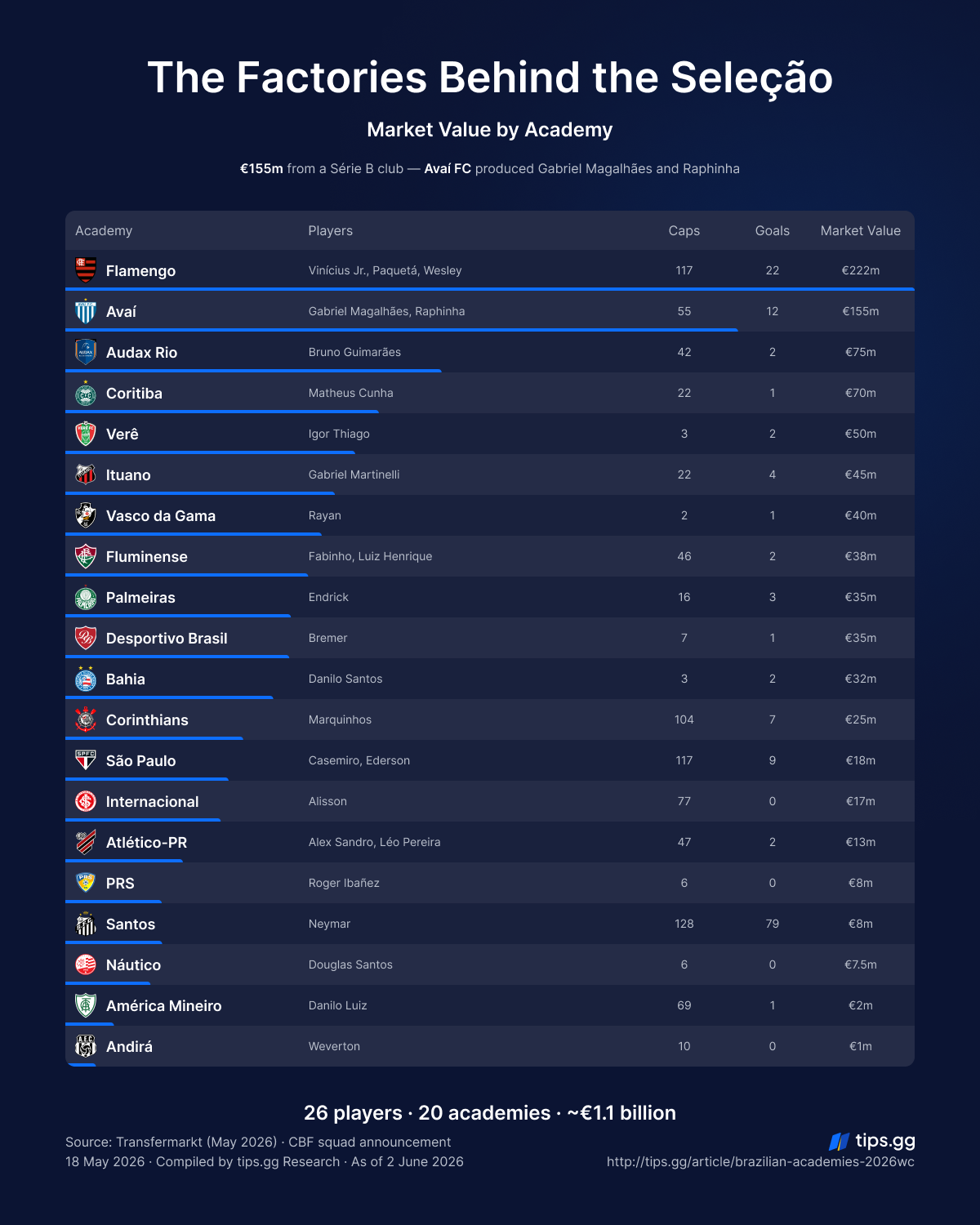
Only one academy produced three World Cup contributors: Flamengo. A further four academies — Avaí, São Paulo, Atlético-PR, and Fluminense — each contributed two. The remaining fifteen academies produced one player each, a distribution that reveals just how wide Brazil’s talent pipeline runs.
Flamengo leads the field. From their youth system came Vinícius Júnior — one of the world’s most expensive players at €150m — alongside Lucas Paquetá and Wesley. The club’s academy did not simply develop talent; it manufactured superstars.
Fluminense contributed a consistent pair: Fabinho and Luiz Henrique, both developed through the club’s long-running youth structure before finding careers abroad.
Avaí FC of Florianópolis is the report’s great hidden story. A club that has spent much of its recent history in Brazil’s second division produced Gabriel Magalhães (€75m, Arsenal) and Raphinha (€80m, Barcelona) — a combined €155m of talent from an academy far removed from the traditional powerhouses.
The breadth of the list is equally striking. Verê, a club from the state of Paraná, developed Igor Thiago over nine formative years. PRS, a modest outfit in Rio de Janeiro state, shaped Roger Ibañez. Andirá, from Paraná, was the earliest and longest stop in Weverton’s youth journey. Brazil’s football infrastructure does not begin and end with the giants.
The Experience Metric: Caps Generated per Academy
If market value measures potential, international caps measure proven, sustained contribution to the Seleção. By this measure, the rankings shift significantly.
Santos FC’s academy stands alone at 128 caps — because one man generates all of them. Neymar Jr., Brazil’s all-time leading scorer, spent his formative years between 2003 and 2009 at Santos, having arrived from Portuguesa Santista at the age of eleven. The return on that investment: 128 senior appearances and 79 international goals.
São Paulo FC’s academy produced 117 caps across two players: Casemiro (85) and Ederson (32). Casemiro has been the defensive anchor of Brazilian football for over a decade — a direct product of São Paulo’s youth philosophy.
Flamengo follows with 117 caps distributed across Vinícius Júnior (48), Lucas Paquetá (62), and Wesley (7). What makes Flamengo’s figure particularly significant is its trajectory: the bulk of those caps belong to players still in the early or middle stages of international careers.
Corinthians produced 104 caps from a single graduate: Marquinhos, the squad captain and arguably Brazil’s most important defender of his generation, now with over a century of senior appearances. The club’s youth system may have produced only one player in this squad, but the quality of that single output places Corinthians among the most impactful academies in this report.
Source: x.com/CBF_Futebol
The Goals Metric: Whose Graduates Decide Matches
Total goals scored for the Seleção reveals attacking potency — and shows how one academy’s graduate reshapes the entire metric.
Santos accounts for 79 of Brazil’s 2026 World Cup squad’s collective 150 international goals — more than half, the bulk of them Neymar’s across nearly two decades of international football. His 0.62 goals per cap is a ratio rarely seen at the international level.
Beyond Neymar, the goals-per-cap ratio reveals who is most decisive relative to their experience:
| Player | Caps | Goals | Goals/Cap | Academy |
|---|---|---|---|---|
| Neymar | 128 | 79 | 0.62 | Santos |
| Raphinha | 38 | 11 | 0.29 | Avaí |
| Lucas Paquetá | 62 | 13 | 0.21 | Flamengo |
| Endrick | 16 | 3 | 0.19 | Palmeiras |
| Vinícius Júnior | 48 | 9 | 0.19 | Flamengo |
| Casemiro | 85 | 9 | 0.11 | São Paulo |
Raphinha’s efficiency makes Avaí’s academy impact more significant than raw cap numbers suggest. And Endrick’s ratio, at 19, points toward a generation that may eventually rival Neymar’s legacy.
The Financial Return: Market Value by Academy
The combined market value of all 26 players in Brazil’s squad is approximately €1.1 billion. The distribution of that value by youth academy reveals which clubs deliver the highest return on their development investment.
| Academy | Players | Caps | Goals | Value |
|---|---|---|---|---|
| Flamengo | Vinícius Jr., Paquetá, Wesley | 117 | 22 | €222m |
| Avaí | Gabriel Magalhães, Raphinha | 55 | 12 | €155m |
| Audax Rio | Bruno Guimarães | 42 | 2 | €75m |
| Coritiba | Matheus Cunha | 22 | 1 | €70m |
| Verê | Igor Thiago | 3 | 2 | €50m |
| Ituano | Gabriel Martinelli | 22 | 4 | €45m |
| Vasco da Gama | Rayan | 2 | 1 | €40m |
| Fluminense | Fabinho, Luiz Henrique | 46 | 2 | €38m |
| Palmeiras | Endrick | 16 | 3 | €35m |
| Desportivo Brasil | Bremer | 7 | 1 | €35m |
| Bahia | Danilo Santos | 3 | 2 | €32m |
| Corinthians | Marquinhos | 104 | 7 | €25m |
| São Paulo | Casemiro, Ederson | 117 | 9 | €18m |
| Internacional | Alisson | 77 | 0 | €17m |
| Atlético-PR | Alex Sandro, Léo Pereira | 47 | 2 | €13m |
| PRS | Roger Ibañez | 6 | 0 | €8m |
| Santos | Neymar | 128 | 79 | €8m |
| Náutico | Douglas Santos | 6 | 0 | €7.5m |
| América Mineiro | Danilo Luiz | 69 | 1 | €2m |
| Andirá | Weverton | 10 | 0 | €1m |
Flamengo leads at €222m — a figure driven largely by Vinícius Júnior’s €150m valuation. Remove him, and Flamengo drops to third. The academy’s greatest achievement was not just developing him; it was recognising what he could become.
Avaí at €155m is the statistical shock of this report. A club from the Brazilian Série B produced two of Europe’s most coveted players — Gabriel Magalhães and Raphinha — making it arguably the most efficient talent development programme in world football by any financial measure.
Verê and Desportivo Brasil are this report’s most unexpected entries. Verê, a youth academy from the interior of Paraná, shaped Igor Thiago over nine years — a player now valued at €50m at Brentford. Desportivo Brasil provided the foundation for Bremer (€35m, Juventus). Neither club will appear in any headline; both left permanent marks on the Seleção.
Audax Rio and Coritiba each produced a single player worth over €70m: Bruno Guimarães (€75m) and Matheus Cunha (€70m) respectively. Both developed at clubs with minimal resources and maximum impact.
Source: x.com/ArsenalBuzzCom
The Paradox: Grown in Brazil, Playing Elsewhere
Of the 26 players in Brazil’s squad, 19 currently play outside Brazil and seven are based domestically. The pipeline still runs heavily through Europe: the Premier League group includes Alisson, Gabriel Magalhães, Casemiro, Bruno Guimarães, Matheus Cunha, Gabriel Martinelli, Rayan, and Igor Thiago; La Liga provides Vinícius Júnior and Raphinha; Ligue 1 includes Marquinhos and Endrick; Serie A accounts for Bremer at Juventus and Wesley at Roma; and Ederson represents the Turkish Süper Lig with Fenerbahçe.
Beyond Europe, Fabinho and Roger Ibañez underline the Saudi Pro League’s pull for experienced Brazilian internationals, while Douglas Santos and Luiz Henrique at Zenit St. Petersburg reflect the wider global spread of Brazilian talent.
Yet for many of these players, the move abroad has never meant a clean break. Vinícius Júnior — now at Real Madrid and among the world’s best — has consistently called Flamengo “the club of my life,” crediting the academy with giving him a better future and taking him out of São Gonçalo. He has promised a return, and on his own terms: “I’ll come back one day, but not when I’m old. I have to win the Libertadores with them.” It is a sentiment that captures the wider paradox of this squad: Brazil exports its talent to the world, but the world never fully takes them.
Seven players are based in Brazil: Weverton at Grêmio; Danilo Luiz, Léo Pereira, Alex Sandro, and Lucas Paquetá at Flamengo; Danilo Santos at Botafogo; and Neymar at Santos. Neymar’s return to the club where his career began adds symbolic weight to that same paradox — one of the game’s defining figures has come home for what may be his final World Cup.
The Next Chapter: Two Academies to Watch
Palmeiras produced Endrick — born in 2006, now valued at €35m, and already carrying 16 Brazil caps and 3 international goals before his 20th birthday. He is the clearest projection of what Palmeiras’ structured youth methodology can produce at elite level.
Vasco da Gama developed Rayan — also born in 2006 and now valued at €40m after his move to Bournemouth. His early senior Brazil record is still thin, but two caps and a first international goal at 19 already point to a player moving quickly through the Seleção pathway. His 11-year spell in Vasco’s academy says plenty about the club’s eye for talent.
Together, Endrick and Rayan represent a generational transition already underway. Both were born in 2006. Both came through major Brazilian academies. And both are now preparing to represent the Seleção at a World Cup.
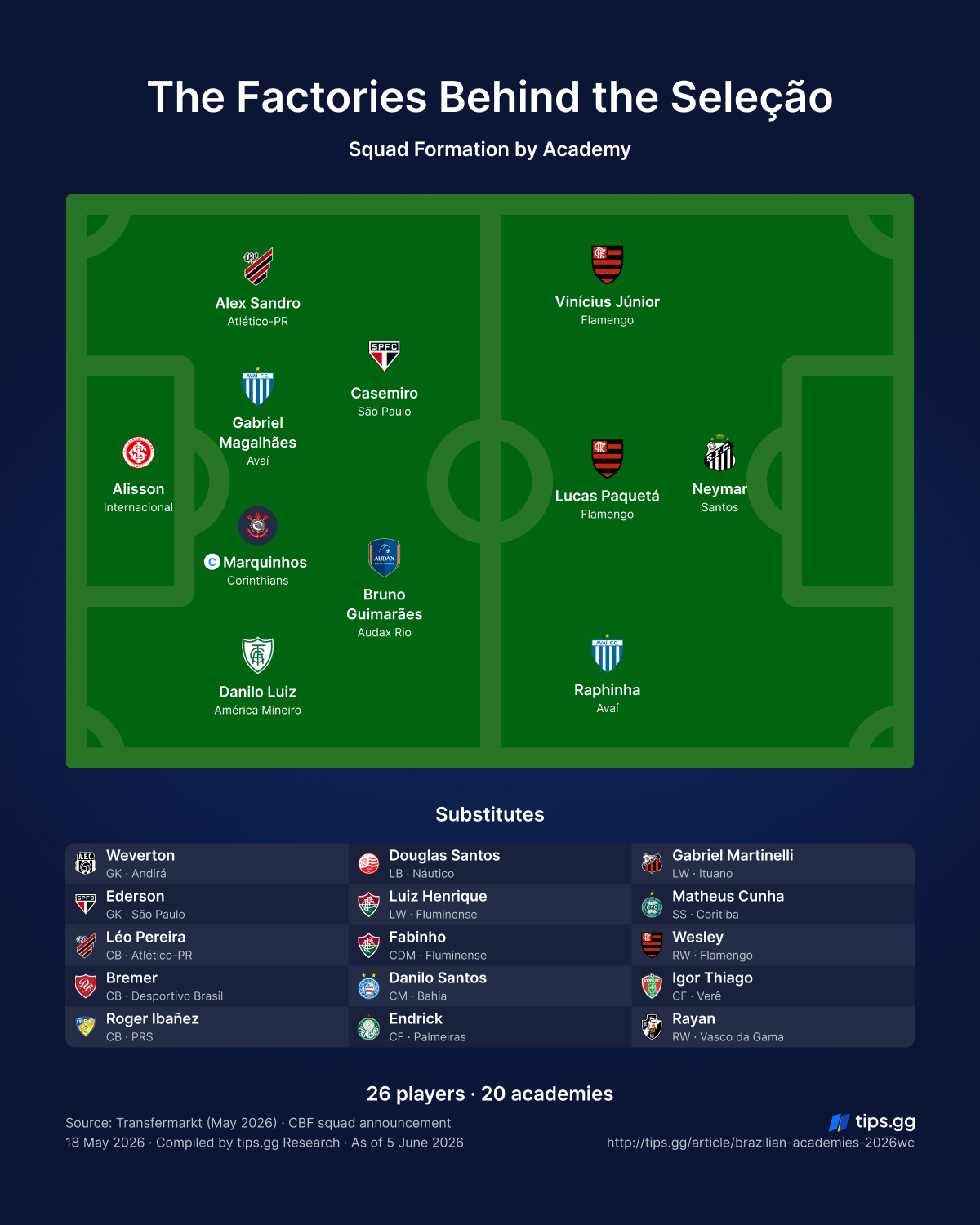
Take a closer look at the academies behind Brazil’s 2026 World Cup squad. This visualization maps every player to the youth system that developed them, revealing the clubs that continue to fuel the Seleção’s talent pipeline and the next generation of stars already making their mark on the international stage.
Download all assets for free here
The Real Tournament Began Years Ago
The 2026 World Cup will take place on pitches in the United States, Canada, and Mexico. But the competition that shaped the result began decades earlier — in youth academies across Brazil, from Rio’s established giants to an obscure club in the interior of Paraná.
Flamengo leads by volume and value. Santos leads by legacy. Avaí leads by efficiency. And the quiet presence of Verê, PRS, Andirá, and Desportivo Brasil in this list is perhaps the most Brazilian detail of all: the talent was always there. Someone just had to find it first.