
Norway arrive at the 2026 World Cup ranked 31st in the FIFA standings — and carrying the most compelling individual storyline of any nation in the tournament. Erling Haaland, the most prolific striker in world football, is finally making his World Cup debut at 25, having watched the previous tournament from home as Norway failed to qualify. That absence haunted Norwegian football. This arrival feels like a reckoning.

Get 200% Bonus up to $500 – FIFA World Cup 2026 on TipsGG × Stake
The FIFA World Cup 2026 is almost here. Follow every match with expert betting tips, live odds, and tournament news – all in one place. Bet smarter with Stake’s 200% Welcome Bonus up to $500.
But Norway are not simply the Haaland show. Martin Ødegaard’s return from injury concerns that disrupted his Arsenal season adds a second elite player to the mix, while a squad that includes Alexander Sørloth, Antonio Nusa, and Sander Berge provides genuine depth across multiple positions. For the first time in a generation, Norway carry a group of players capable of competing not just with ambition, but with real technical quality.
Placed in Group I alongside France (1st in the world), Senegal (14th), and Iraq (57th), Norway face the most demanding immediate challenge available. France are the tournament’s top-ranked side and clear group favourites. Senegal are organised, athletic, and experienced. Norway’s path to the knockout rounds is narrow but credible — and if they navigate it, the tournament opens up considerably.
The 2026 World Cup represents not just Norway’s return to the global stage after missing 2002, 2006, 2010, 2014, and 2018 — it is their most genuinely exciting squad in decades, built around two players capable of influencing a tournament at the highest level.

Norway World Cup History: Results, Stats & Past Performances
Norway’s World Cup history is brief and largely unremarkable — which makes the anticipation surrounding 2026 all the more significant. They have appeared at just four World Cups, their most recent participation coming in 1998 in France, where they exited in the Round of 16 after defeating Brazil in the group stage in one of the tournament’s most famous upsets.
That 1998 campaign remains the peak of Norwegian World Cup football. Tore André Flo and Ole Gunnar Solskjær were the attacking forces, and the win over Ronaldo’s Brazil — which finished 2–1 — sent shockwaves through the tournament. They subsequently lost to Italy in the Round of 16 and exited with credit, but without reaching the quarter-finals.
Before 1998, Norway appeared at the 1938 World Cup — a single match, a defeat to Italy — and then in 1994, where all four teams in the quartet finished the group stage with four points and a goal difference of 0. However, just one goal scored was a black mark that left the Scandinavian team on the last line of the table.. The pattern across their appearances is consistent: solid defensive organisation, clinical use of physical forward play, and an inability to progress beyond the last sixteen.
The intervening 28 years — from 1998 to 2026 — have been defined by qualification failures that made Norwegian football feel increasingly disconnected from the elite level. The rise of Haaland and Ødegaard has changed that narrative fundamentally. This squad, by any objective measure, is the most talented Norway have assembled for a major tournament.
How Norway Qualified for the 2026 World Cup: Results & Recent Form
Norway qualified through UEFA after years of near-misses that became a source of national frustration. The qualifying campaign was defined by efficiency — Norway won all matches, defended well in the tighter fixtures, and relied heavily on Haaland’s goals to resolve difficult games.
Haaland finished as the top scorer in the UEFA qualifying section by a significant margin, contributing goals across a range of match types — headers from crosses, finishes in tight areas, and the kind of long-range efforts that have become a feature of his game at Manchester City. His presence alone altered how opponents set up against Norway, creating space that Ødegaard and Sørloth could exploit.
The qualifying run also confirmed some concerns. Without Ødegaard at full capacity, Norway’s creative structure became more direct and less nuanced — a dependence that becomes relevant heading into the tournament, given Ødegaard’s recent injury history. Against compact, well-organised defences, Norway’s build-up play can become one-dimensional, relying on crossing and long balls into Haaland rather than constructing chances through combination play.
Recent form in friendlies fixtures has been ambiguous: a draw with Switzerland and a defeat by the Netherlands. However, drawing conclusions about the tournament based on the games in March, which had no tournament motivation, is naive.
Norway Squad for the 2026 World Cup: Key Players, Lineup & Team News
Norway carry genuine elite quality in key positions, though the drop in level beyond the top five or six players is notable. The squad is largely European-based, with strong representation from the Bundesliga, Serie A, and Premier League.
Norway 2026 FIFA World Cup squad
- Goalkeepers: Orjan Haskjold Nyland (Sevilla), Egil Selvik (Watford), Sander Tangvik (Hamburger SV).
- Defenders: Julian Ryerson (Borussia Dortmund), Marcus Holmgren Pedersen (Torino), David Moller Wolfe (Wolverhampton), Fredrik Bjorkan (Bodo/Glimt), Kristoffer Ajer (Brentford), Torbjorn Heggem (Bologna), Leo Skiri Ostigard (Genoa), Sondre Langas (Derby County), Henrik Falchener (Viking).
- Midfielders: Martin Odegaard (Arsenal), Sander Berge (Fulham), Fredrik Aursnes (Benfica), Patrick Berg (Bodo/Glimt), Kristian Thorstvedt (Sassuolo), Morten Thorsby (Cremonese), Thelo Aasgaard (Rangers).
- Forwards: Erling Haaland (Manchester City), Alexander Sorloth (Atletico Madrid), Jorgen Strand Larsen (Crystal Palace), Antonio Nusa (RB Leipzig), Oscar Bobb (Fulham), Andreas Schjelderup (Benfica), Jens Petter Hauge (Bodo/Glimt).
Expected Formation: 4-3-3 / 4-2-3-1
Key Players:
Erling Haaland (Manchester City, CF) — The defining player of this generation and the most discussed individual in the tournament. Haaland’s physical statistics — pace, aerial dominance, finishing technique, pressing intensity — are elite by any measure. He has scored at a rate no striker in world football can currently match at club level, and the question for Norway is simply whether the tournament’s slightly slower, more organised pace suits his profile. At 25, this is his first World Cup and very possibly his best.
Martin Ødegaard (Arsenal, CAM) — The creative intelligence to Haaland’s physical force. Ødegaard’s ability to operate between the lines, receive under pressure, and produce precise passes through defensive structures is the element that elevates Norway from a physical team to a technically capable one. His fitness across a full tournament is the most important uncertainty in Norway’s squad — without him at full capacity, the attacking structure becomes significantly more limited.
Alexander Sørloth (Atlético Madrid, ST/CF) — One of the most underrated strikers in international football. Sørloth’s physical presence, aerial ability, and league-level finishing at Atlético Madrid make him a credible second striker or central option when Haaland is rotated or unavailable. His partnership with Haaland in a two-striker system also offers Norway a different attacking shape.
Sander Berge (Fulham, CM) — The midfield anchor and one of Norway’s most complete players in central areas. Berge’s physical profile — tall, strong, technically capable — allows him to compete in the pressing duels that determine the midfield battle in tournament football. His ability to switch play and recover possession makes him essential to Norway’s structure.
Antonio Nusa (RB Leipzig, LW) — The most exciting young talent in the squad. Nusa’s pace, directness, and confidence on the ball give Norway a wide option capable of beating defenders in one-on-one situations. His development at RB Leipzig has been rapid, and at 21, this tournament could mark his emergence on the global stage.
Fredrik Aursnes (Benfica, CM) — A technically disciplined midfielder whose pressing intensity and positioning provide tactical balance when Norway want to dominate possession. Aursnes’ work at Benfica has matured his game beyond the pressing-first profile of his earlier career.
In goal, Ørjan Haskjold Nyland provides reliable experience from his time at Sevilla, though he is not a goalkeeper whose distribution ability will fundamentally change how Norway build from the back.
The squad’s main vulnerability is in the full-back positions, where the options are competent but lack the attacking quality of Norway’s best players further forward. Julian Ryerson at right back is the most balanced option, combining defensive discipline with occasional forward runs.
Norway Coach, Tactics & Analysis for the 2026 World Cup
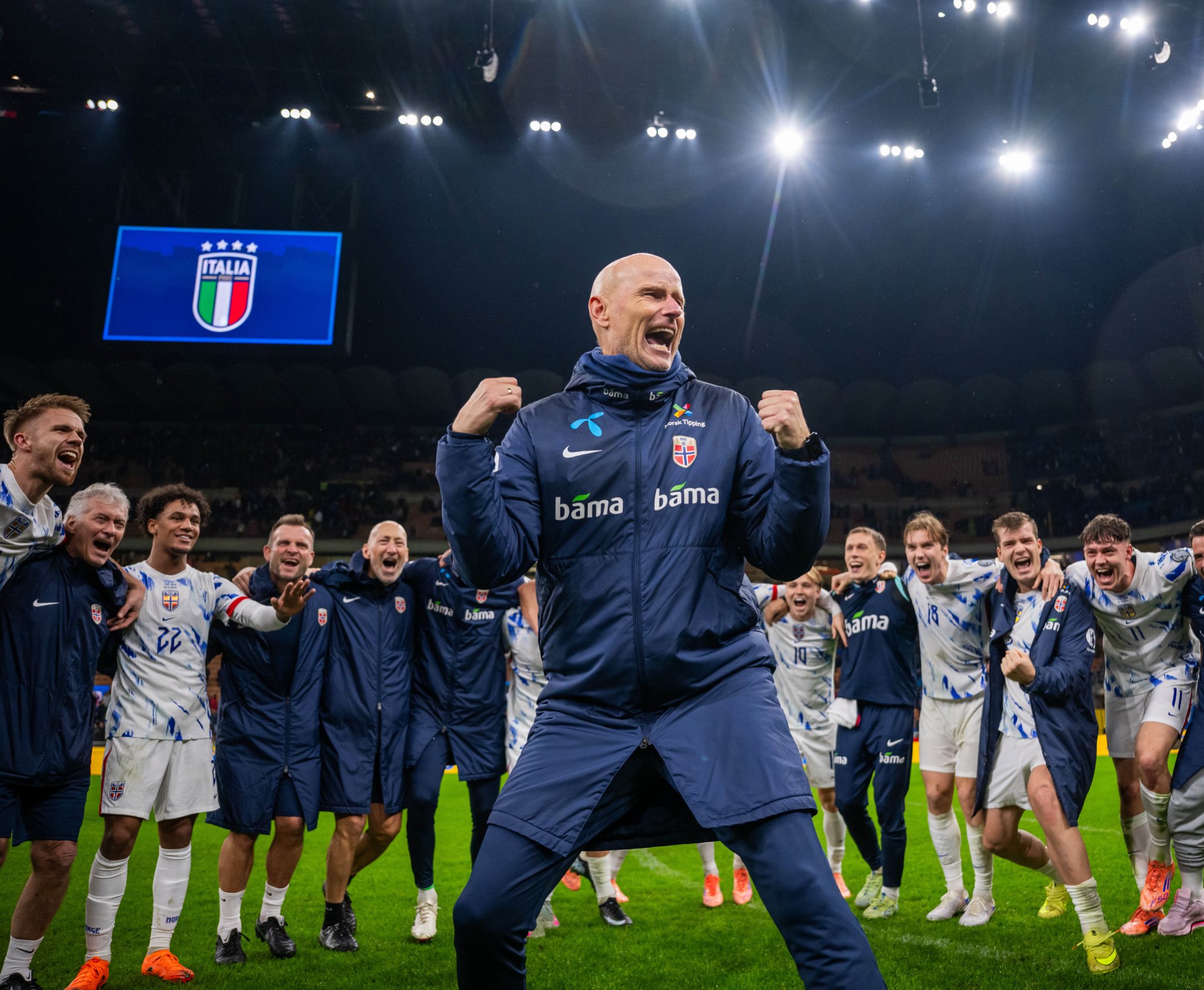
Norway are managed by Ståle Solbakken, the experienced Norwegian coach who has overseen the squad’s development through the qualification process and into tournament preparation. Solbakken’s philosophy is built around tactical flexibility — Norway can play in multiple shapes, adjusting to the demands of individual opponents rather than imposing a fixed identity regardless of context.
The primary setup is a 4-3-3 that transitions into a 4-2-3-1 in defensive phases, with Haaland as the focal point and Ødegaard operating in the half-space behind or alongside him. The full-backs push high when Norway have possession, creating width that allows Nusa and the right winger to operate closer to goal.
Against weaker opponents, Norway press high and look to win the ball in the final third, with Haaland’s pressing intensity — often underappreciated given his goalscoring profile — creating turnovers in dangerous areas. Against stronger sides, Solbakken drops the defensive line and invites opponents to commit forward, using the space behind for Haaland’s runs.
The tactical challenge for Norway in Group I is clear: France’s possession game will deny the space Haaland needs to be most dangerous. Senegal’s athleticism and physicality will test Norway’s pressing structure. Iraq, ranked 57th, represents the clearest opportunity to express the team’s natural attacking identity.
Solbakken’s biggest strength is his willingness to adapt tactically mid-tournament — something that has served Norway well in qualifying but will be tested against the depth of opposition in Group I and potentially beyond.
Source: x.com/_BeFootball
Norway Fixtures (Match Schedule) at 2026 World Cup
Norway are in the tournament’s most challenging group relative to their seeding, but carry enough quality to compete in all three fixtures.
Strengths:
Haaland is the most physically dominant striker in the tournament. Ødegaard’s creative intelligence elevates the entire attacking structure. Sørloth provides a credible second forward option — rare depth at international level. Tactical flexibility under Solbakken allows adjustments between matches. Nusa’s pace and directness adds an unpredictable wide threat.
Weaknesses:
Heavy dependence on Ødegaard’s fitness — the creative structure suffers significantly without him. Full-back quality limits Norway’s ability to create overloads in wide areas. Against elite possession sides, the high defensive line can be exposed. The squad’s quality drops sharply beyond the top six or seven players.
Group I Schedule:
Match 1: vs Iraq — June 17, 00:00 CEST. The must-win opener. Iraq are ranked 57th and making their first World Cup appearance since 1986. Norway should control this fixture comfortably and use it to establish rhythm and confidence heading into more demanding games.
Match 2: vs Senegal — June 23, 02:00 CEST. The decisive group fixture for Norway. Senegal, ranked 14th, are physically imposing and dangerous from set-pieces. A draw here, combined with a win over Iraq, would almost certainly secure qualification. Haaland versus Senegal’s defensive line is the individual matchup that defines this game.
Match 3: vs France — June 26, 21:00 CEST. France will likely have already qualified before this fixture and may rotate. If Norway arrive at this match having secured their own progression, Solbakken can set up conservatively and limit France’s counter-attacking effectiveness. If Norway still need a result, France’s quality — even rotated — makes this an extremely difficult ask.
The most realistic path to qualification is a win over Iraq, a draw against Senegal, and a managed performance against France. That scenario puts Norway into the Round of 32 as group runners-up.
Norway Odds & Best Bets for the 2026 World Cup: Value Picks & Predictions
Outright and Group Markets:
| Market | Odds | Bookmaker | Value? |
|---|---|---|---|
| Reach Round of 16 | 1.80 | Sapphirebet | Medium |
| Reach Quarter-finals | 2.75 | Sapphirebet | Yes |
| Reach Semi-finals | 5.00 | Sapphirebet | Yes |
| Reach Final | 13.00 | Sapphirebet | Low |
| Win World Cup | 26.00 | Sapphirebet | No |
Analysis:
The Round of 16 at 1.80 is priced as a coin-flip — an implied probability of roughly 56% for a team whose group progression depends on beating Iraq and not losing to Senegal. Given Norway’s squad quality against those two opponents specifically, this feels slightly underpriced. Norway are realistically a 65–70% probability to qualify, making 1.80 a mild value proposition rather than a clear recommendation.
The Quarter-finals at 2.75 is the most compelling market in Norway’s column. An implied probability of ~36% for a team containing Haaland and Ødegaard, with a realistic path through the knockout rounds, undervalues their individual match-winning capacity. If Norway qualify from the group — which is the probable rather than speculative outcome — they enter a Round of 32 where the draw could hand them a manageable opponent. One Haaland performance can eliminate virtually any side.
The Semi-finals at 5.00 is genuinely interesting. An implied probability of 20% for a team ranked 31st in the world feels generous only until you factor in the individual quality ceiling. Norway’s ceiling in this tournament is not defined by their ranking — it is defined by whether Haaland and Ødegaard are fit, in form, and supported by a functional structure. On those conditions being met, reaching the semi-finals is not a fantasy. It is a realistic upside scenario.
Where the clearest value lies:
Norway to Qualify from Group (priced within accumulator markets, implied ~1.55–1.70) combined with Haaland to Score in the Tournament offers the most coherent entry point. Norway’s group progression is probable rather than certain, and Haaland’s goalscoring record at every level makes his tournament contribution the safest individual bet in Norway’s market.
The Quarter-finals at 2.75 is the standout recommendation for bettors willing to back a team whose ceiling depends on two elite individuals. The market is correctly cautious about Norway’s squad depth, but slightly too cautious about their individual match-winning capacity.
Erling Haaland Golden Boot (~8.00–10.00 where available) — a speculative but defensible longshot. If Norway progress to the quarter-finals or beyond, Haaland will have played five or more matches against sides where his physical superiority and finishing quality create consistent opportunities. Among the realistic Golden Boot candidates at longer odds, he is the most credible.
Recommended Bets:
1. Norway to Reach Quarter-finals (2.75) — Value bet. An implied 36% probability undervalues a team with two world-class players and a credible path through the group. One Haaland performance can define a knockout tie.
2. Norway to Qualify from Group (~1.60–1.70 in accumulators) — Safe/Value bet. Iraq and Senegal are beatable, and Norway’s quality in key positions should be sufficient to take at least four points from those two fixtures.
3. Erling Haaland Anytime Scorer — Group Stage (~1.30–1.45) — Safe bet. He is the most physically dominant striker in the tournament, will play all three group matches, and faces Iraq and Senegal — neither of which has the defensive depth to consistently contain him.
4. Norway Semi-finals (5.00) — Speculative value. At 20% implied probability, this is worth a small stake for bettors who believe Haaland’s individual capacity can carry Norway into the latter stages. The ceiling is there; the floor is a Round of 16 exit.
Risk Factors:
Ødegaard’s fitness is the single most significant variable in Norway’s tournament — his absence transforms Norway from a technically nuanced side into a more direct, predictable team. France’s possession game in Match 3 could expose Norway’s high defensive line even with rotation. Senegal’s physicality is the type of challenge that historically disrupts Scandinavian pressing sides. Norway’s squad depth beyond the top six makes fatigue management across a compressed schedule a genuine concern.
Norway Prediction for the 2026 World Cup: Can They Qualify from Group?
Yes — with a win over Iraq and at least a draw against Senegal as the target. Norway are better than Iraq and broadly comparable to Senegal, and their individual quality in attacking positions gives them the edge in both fixtures when the game is open.
The France fixture arrives third, by which point Norway may already be qualified and able to approach the match without the full pressure of needing a result. That context makes what looks like an impossible game considerably more manageable.
Beyond the group, everything depends on the knockout draw and Ødegaard’s fitness. A Norway side with Haaland and Ødegaard both at full capacity, drawn against a mid-tier team in the Round of 32, is entirely capable of reaching the quarter-finals. The semi-finals require a sequence of performances and results that is unlikely but not implausible.
Realistic projection: Round of 16 exit as the most probable outcome, quarter-finals as the realistic ceiling. A semi-final run would represent one of the tournament’s great stories — and, given the players involved, not an entirely impossible one.
Norway 2026 World Cup FAQ: Predictions, Odds & Key Questions
Will Norway qualify from Group I at the 2026 World Cup?
Probably, but not certainly. A win over Iraq is the minimum requirement, and a draw against Senegal would almost guarantee progression. Norway’s individual quality in attack gives them the edge in both those fixtures, but Senegal are a challenging opponent capable of disrupting Norway’s pressing structure.
What are the best bets on Norway?
Norway to reach the quarter-finals at 2.75 offers the most coherent value — an implied 36% probability undervalues a team with Haaland and Ødegaard. The group-stage qualifier market in accumulators is the safer supporting option.
Who is Norway’s main goalscorer?
Erling Haaland, without question. He is Norway’s primary goalscoring channel, the player opponents organise to contain, and the most physically dominant striker in the tournament. Alexander Sørloth provides backup, but the difference in quality between them is significant.
Can Norway win the 2026 World Cup?
Unlikely. At 26.00, the market is broadly correct — Norway’s squad depth beyond their top players is insufficient to sustain a seven-match tournament run at the elite level. The semi-finals represent the realistic ceiling of optimism.
What is Norway’s biggest tactical strength?
Haaland’s physical dominance in the penalty area and on the shoulder of the last defender creates chances that no defensive setup can entirely eliminate. Combined with Ødegaard’s through-ball quality, Norway’s direct attacking threat is elite even against the best defences.
What is Norway’s main weakness?
The drop in quality beyond Haaland and Ødegaard. Against sides that can neutralise both — through physical pressing on Ødegaard and a deep defensive block against Haaland’s runs — Norway’s other creative options are not of sufficient quality to generate a consistent alternative.
Is this Norway’s best ever World Cup squad?
By most objective measures, yes. The combination of Haaland’s goalscoring capacity and Ødegaard’s creative intelligence gives Norway a quality ceiling that their previous World Cup squads — including the 1998 side that beat Brazil — could not match.
How important is Ødegaard’s fitness to Norway’s chances?
Critically important. Norway with Ødegaard at full capacity is a genuinely dangerous team capable of beating sides ranked significantly above them. Norway without Ødegaard is a more direct, more predictable side whose effectiveness depends almost entirely on Haaland’s individual moments.
Is Norway a Good Bet at the 2026 World Cup?
Norway enter the 2026 World Cup as the tournament’s most compelling individual narrative — finally here, finally with Haaland, finally with a squad that matches the talent of the players asking to be taken seriously at the global level.
From a betting perspective, the quarter-final market at 2.75 stands out as the strongest value proposition. It acknowledges the realistic ceiling without overstating Norway’s depth. For bettors comfortable with more risk, the semi-final at 5.00 offers a speculative but defensible longshot built around the individual ceiling of one of football’s most physically dominant players.