 Sulfur
CS:GO has a major flaw at its very core. I’m the tinfoil guy who’s gonna prove that everything we see and everything we enjoy is a fine-tuned lie, created with a wand of deception and deceit. Many have slightly touched on the topic, without a deeper realization about the truth that leeches into the soul of the game we love.
Okay, unnecessary dramatics aside, this is an article about how real-life distances and lengths do not rationally translate into Hammer, the editor used to create CS:GO maps.
Check this thread out. If it interests you, read my article and I’ll tell you something genuinely shocking about how deep this problem is, and how Valve has literally done nothing to fix it, cheaply covering it up for two decades, instead.
Here’s the story of my accidental discovery.
My Journey with SDK
I moved to a new home after having lived in my older one for 9 years. As the moving date shifted closer and closer to me, my sadness and emptiness, in a way, kept growing, as I prepared to leave this life behind.
I had watched a lot of Philip’s videos, and I had fallen in love with the imaginary version of me that creates beautiful maps and sees the world through the rosy lens of an artist.
Yet, I could never break the spell of procrastination the lazy me had cast on myself. After a plout of inspiration pushed me to open CS:GO SDK and see how the CS:GO world looks from Hammer, I found out that the tool is only available for people who had bought CS:GO Prime. That added to my procrastination, now with an extra layer of financial obstacles.
But as the dreaded day crawled yet closer, I kept getting depressed about not having a sweet souvenir of the times well spent. And then the two got married in my head at night.
I rushed to my beloved PC, pulled out my debit card, and bought CS:GO Prime.
I was gonna map my own home.
I spent the first few hours in SDK by opening pre-existing BSP files in the “maps” folder and just running around Dust 2 and Nuke. It was rather complicated at first, and I didn’t really understand what things meant, but I had a lot of fun.
The next day, I woke up and pulled out Philip’s SDK tutorials. I followed along with him, learning the basics. I spent some time in the SDK myself, creating random brushes and adding different textures to them. Soon, I got a basic gist of how to create something as simple as a room.
I got lost in the rabbit hole of Clipping Tool and Vortex, all while trying to figure out how to make a hole in a wall, as in a window. Thanks to Redditors, I abandoned my initial idea and did it the “right” way: four different brushes. Tiresome, but that’s the best I could do, especially when thrust against a serious time constraint.
With just one week to go, I had to map a basic outline of the whole house and a detailed version of my room.
The Umbilical Cord of CS:GO from Real Life
To start with, I had to make a connection between CS:GO units and real life. Instead of going on Reddit and searching if anyone had done that already, I decided to do it for myself. The quantity that I assumed would remain constant, regardless of what engine I’m in, would be time.
Since I was creating my own home, I had to get the timings right.
So I walked at a reasonable pace from one corner of my room to the other and calculated the time it took. Since I knew the distance I walked, I had the first piece in my hand.
Next, I pressed Shift and walked the same amount of time in-game. I realized I am stupid because I cannot measure distance walked in-game (easily/directly).
So I just walked again from one end to another in-game and measured the time. The difference is that I did this in my own basic one-box map, so I knew its dimensions and the units that I had walked.
And just like that, some basic ratio calculations later, I had reached this golden formula:
1 inch IRL = 3.75 units in Hammer.
For as clumsy as I am, I tested my calculations for the next few hours, and it turned out right every time.
I was ready to create my first map.
I made the basic outline of my boxy home. It was easy since my home was almost rectangular. Then I made the walls of each, and one by one, I created the rooms.
I compiled and ran it once in a while to see how it looks, and since I didn’t have any height reference (nor any reason to look up), the glaring issue in my map, or CS:GO in general, kept skipping over me, over and over again.
Eventually, I had created the basic outlines of every single room, and since I love the kitchen, I thought of starting from there to make some basic details. I had been running around my home with a tape, measuring all distances from wall to wall, and then converting the inches to CS:GO units. (It took my micro intellect some time to realize I could just measure the dimensions of one tile, and then use the number of tiles + remaining length as a measuring method.)
Well, I unsuspectingly did the same to the waist-level kitchen counter. I measured the height, converted it to CS:GO units, and happily created kitchen counter brushes in Hammer.
I compiled it, and then it hit me. Heights in CS:GO are completely broken.
The Fault in Our Star
The counter that was supposed to end at waist level was completely going over the head of my CS:GO character model.

More a blackboard than a counter.
That is the deep flaw in the very core of CS:GO. Of course, it only affects a narrow slice of mappers, who themselves are a narrow slice of all the people that are involved in CS:GO.
For all practical purposes, a map can easily be created with the height issue kept in mind, and no harm will be done. The game still runs without us making a fuss about it.
Except me.
I got very mad after this. Not only are the scales weirdly broken from the inside, but now things are much more difficult to do, especially with the time constraints. After ranting about this problem in my Insta Stories, I got back to work.
I looked up the height of a CS:GO player model. It’s 72 units. Using my calculations, which are definitely true for normal x and y axes’ lengths, the height of a CS:GO player model is 19.2 inches.
Yeah, for real.
The average height of a dwarf is 36 inches, btw. Our CS:GO guy is a dwarf for a dwarf.
The Redditors in the thread at the start of this article used a Dust 2 car and its model to calculate the height of the guy. They deemed him some sort of a midget and determined that his height is 152 cm/60 inches.
Pfft. Painfully wrong amateurs.
So yeah, x-axis and y-axis is the happy couple we all love. Z-axis is the divorced and single, stuck-up snob that everyone hates to invite to their family occasions. I remember how he scowled after seeing the pretty face of my newborn cousin. AHole.
Okay, weird rant over.
When I was completing my map, I just went with my gut instead of figuring out this new formula. My units were “me but half”, “till my waist”, “one grande cup above my head” and the likes. I used “till my knees at least, pls” for my bed. (Not one venti cup above my head because I’m poor XD)
In the end, this problem domino-d into me having to delete a lot of stuff. My ceilings, cutting off walls (not necessary but the inconsistency irked me), etc. There were “holes” in my walls to keep stuff, like this.
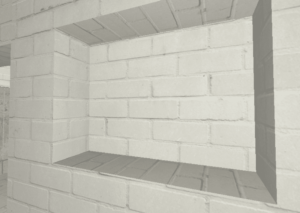
These created the craziest problems. Remember that I said that creating a window requires 4 brushes? Creating a “hole” requires 5 or 6. And adjusting these took forever.
In the end, I created boxes for 2 main rooms, a basic kitchen with a fridge and a kitchen counter, and an okayishly detailed version of my room. It had a bed, some cupboards, my computer table, the dining table, and my black as hell CPU.
I was still juggling the basics at this point, so I’m sure I was inefficient in what I did. Since things seemed to be so personalized, I never really thought about using pre-existing models. I didn’t waste time exploring that.
I was to move 2 days later. I had abandoned all my studies for this map by this point, all to bear a fruit not so sweet. At least not as sweet as I thought it would be when I started this project. But that’s how life is, I guess.
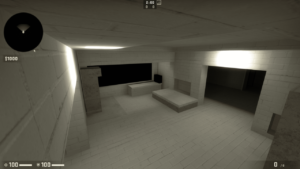
In the end, the real souvenir wasn’t me accurately recreating my ex-home in SDK; it was me brewing a deep love for mapping as I bid my home goodbye. And in that, my home and my memories in it have been immortalized.