
Ranked 11th in the April 2026 FIFA standings, Croatia arrive at their seventh consecutive World Cup as the tournament’s most dependable overachievers. A country of under four million people has reached two World Cup semi-finals and one final in the last two editions. No statistical model can fully account for what Zlatko Dalić’s side does when a knockout match is on the line.

100% 1st Deposit Bonus up to €750 + 100 FS — FIFA World Cup 2026 on TipsGG × Casino Prestige
Follow every match of the FIFA World Cup 2026, analyze live, and place bets on the best terms. Get a 100% bonus up to €750 + 100 FS on Casino Prestige and don’t miss the chance to boost your bankroll for the biggest tournament of the year.
Qualification from UEFA Group L was authoritative. Seven wins from eight matches, 26 goals scored, four conceded, with a 3-1 victory over the Faroe Islands confirming first place ahead of Czechia. The campaign answered the questions raised by a poor Euro 2024 — two points, group-stage exit — and reasserted that Croatian football still has the quality to dominate at UEFA level when the system functions correctly.
What makes this edition of the Vatreni different from those that preceded it is the weight of finality surrounding Luka Modrić. At 40, the 2018 Ballon d’Or winner has stated explicitly that this is his last major tournament. He said the same before Euro 2024, and the tournament ended in disappointment. The 2026 World Cup is the last chapter. The question is whether the supporting cast — Mateo Kovačić recovering from Achilles surgery, Joško Gvardiol returning from a leg fracture, a midfield transitioning between generations — can function well enough to give him the send-off his career demands.
In Group L, Croatia face England, Ghana and Panama. It is a group they are capable of winning. It is also a group that will expose them immediately if the fitness concerns are not resolved before June.
Croatia World Cup History: Results, Stats & Past Performances
Croatia’s World Cup record is extraordinary in proportion to the country’s size. Since their first appearance in 1998 — where they finished third in France, with Davor Šuker winning the Golden Boot — the Vatreni have qualified for every subsequent tournament except 2010, accumulating a record that most nations with ten times the population would envy.
The peak arrived in 2018 in Russia, where Dalić’s side beat Argentina, Russia, Denmark and England on the way to a final against France. They lost 4–2 to a Kylian Mbappé-inspired French side in Moscow, but the journey — three consecutive knockout wins in extra time, including the penalty shootout against Russia and the golden-goal drama against Denmark — remains one of the great tournament runs in modern history.
In Qatar in 2022, Croatia produced another remarkable campaign. They eliminated favourites Brazil in the quarter-finals on penalties, with Dominik Livaković saving three spot-kicks, before losing to eventual champions Argentina in the semi-finals. Third place was secured with a 2–1 win over Morocco. It was the second time in five years they had finished on the podium.
In 2014, they exited in the group stage after a controversial defeat to Brazil. In 2006, they went out in the group stage again despite a talented squad. The pattern that emerges is one of extremes — when Croatia’s system functions and the big players are available, they can beat anyone. When it does not, the limitations of a shallow talent pool are exposed immediately.
Euro 2024 provided the cautionary tale. Two points in the group stage, early elimination, and genuine questions about whether Modrić’s midfield still had the legs to press at tournament intensity. The 2026 qualifying campaign answered those questions, but one UEFA qualifier group and one major tournament group stage are very different environments.
How Croatia Qualified for the 2026 World Cup: Results & Recent Form
Croatia topped UEFA Group L with a record of seven wins and one draw across eight matches, scoring 26 goals and conceding just four. The single dropped points came in a draw against Czechia — their only realistic rival for first place — but Croatia never relinquished top spot. The clinching moment was a 3-1 home win over the Faroe Islands that confirmed first place and direct qualification.
The March 2026 friendlies provided more nuanced insight into the team’s current condition. Against Colombia on March 26, Croatia went behind inside two minutes to Jhon Arias before Luka Vušković’s deflected long-range effort equalised in the sixth minute. Igor Matanović headed the winner from a corner in the 42nd minute — a result that demonstrated the resilience and set-piece quality that defines this squad. Three days later against Brazil, Croatia competed well until the final ten minutes, when two late goals turned a competitive match into a 3-1 defeat that flattered the opponent.
The fitness picture clouds the form assessment. Kovačić was absent from the March squad following Achilles surgery. Gvardiol missed the same window with a leg fracture. Modrić is set to undergo left cheekbone surgery before the tournament. If all three are available by June, Croatia’s ceiling in Group L is considerably higher than the March results suggest. If they are not, Dalić will be managing around absences that fundamentally change what his team can do.
Current form across the last ten competitive matches: seven wins, two draws, one defeat. The defeat came against a Brazilian side that needed two stoppage-time moments to win. The overall trajectory is upward from the Euro 2024 low point, but the fitness dependencies make any confident projection contingent on medical news.
Croatia Squad for the 2026 World Cup: Key Players, Lineup & Team News
Croatia’s squad combines the most experienced generation in the country’s football history with a midfield transition that will define the next decade of the programme. Four of the six all-time caps leaders — Modrić, Perišić, Kramarić and Kovačić — are in the squad. So are the players most likely to replace them.
Expected Starting XI (4-2-3-1): Livaković; Stanišić, Vušković, Ćaleta-Car, Gvardiol; Kovačić, Modrić; Pašalić, Kramarić, Perišić; Budimir.
Luka Modrić (40, AC Milan, CM) — The 2018 Ballon d’Or winner, Croatia’s all-time caps leader with 194 appearances, and the player around whom everything in the Croatian system is constructed. His ability to find space, control tempo and deliver passes that others cannot see remains intact, even as the physical demands of pressing for 90 minutes have increased with age. Managing his minutes across three group matches while preserving him for knockout rounds is Dalić’s most important tactical decision. This is his last World Cup, and the Croatian football association, the squad and the nation know it.
Mateo Kovačić (32, Manchester City, CM) — The box-to-box midfielder who provides the energy and defensive coverage that allows Modrić to operate freely. His Champions League experience with Real Madrid, Chelsea and Manchester City gives Croatia’s midfield a technical ceiling that few nations can match. The Achilles surgery that kept him out of March is the single most consequential fitness concern — without him, the midfield balance shifts and Modrić is more exposed. His return to full fitness before June is the headline medical story of Croatia’s pre-tournament preparation.
Joško Gvardiol (24, Manchester City, CB/LB) — Named to the Team of the Tournament at the 2022 World Cup at 20 years old, Gvardiol has since become one of the best defenders in the Premier League. His ability to carry the ball from deep, cover enormous ground and win aerial duels gives Croatia’s defensive line a quality that elevates the entire team. The leg fracture that ruled him out in March must be fully healed before June — his absence against England would be the most significant single-player loss Croatia could suffer.
Andrej Kramarić (34, Hoffenheim, AM/ST) — Six qualifying goals and 36 international strikes across his career confirm his continued reliability in front of goal. At Hoffenheim he has increasingly operated as a number ten rather than a central striker, and Dalić has adapted his role accordingly — deploying him in the half-spaces behind Budimir to exploit the pockets of space that Modrić’s movement creates. Croatia’s second all-time leading scorer behind Davor Šuker’s 45 goals, with Ivan Perišić on 38 in third.
Martin Baturina (23, Como, CM) and Petar Sučić (22, Inter Milan, CM) and Luka Sučić (23, Real Sociedad, CM) — The three midfield candidates most likely to succeed the Modrić generation. Baturina’s technical composure at Como, Petar Sučić’s development at Inter Milan and Luka Sučić’s creativity at Real Sociedad represent genuinely exciting futures. This World Cup is their audition, and the Modrić farewell narrative gives them the perfect context to announce themselves.
Modrić faces cheekbone surgery before the tournament. Kovačić and Gvardiol are working back from injury. All three are expected to be available for June but none have been confirmed as fully fit at the time of writing.
Full Squad:
Goalkeepers: Dominik Kotarski (Copenhagen), Dominik Livaković (Dinamo Zagreb), Ivor Pandur (Hull City).
Defenders: Duje Ćaleta-Car (Real Sociedad), Joško Gvardiol (Manchester City), Martin Erlić (Midtjylland), Marin Pongračić (Fiorentina), Josip Stanišić (Bayern Munich), Josip Šutalo (Ajax), Luka Vušković (Hamburger SV).
Midfielders: Martin Baturina (Como), Toni Fruk (Rijeka), Kristijan Jakić (FC Augsburg), Mateo Kovačić (Manchester City), Luka Modrić (Milan), Nikola Moro (Bologna), Mario Pašalić (Atalanta), Petar Sučić (Inter Milan), Luka Sučić (Real Sociedad), Nikola Vlašić (Torino).
Forwards: Ante Budimir (Osasuna), Andrej Kramarić (Hoffenheim), Igor Matanović (SC Freiburg), Petar Musa (FC Dallas), Marco Pašalić (Orlando City), Ivan Perišić (PSV Eindhoven).
Croatia Coach, Tactics & Analysis for the 2026 World Cup
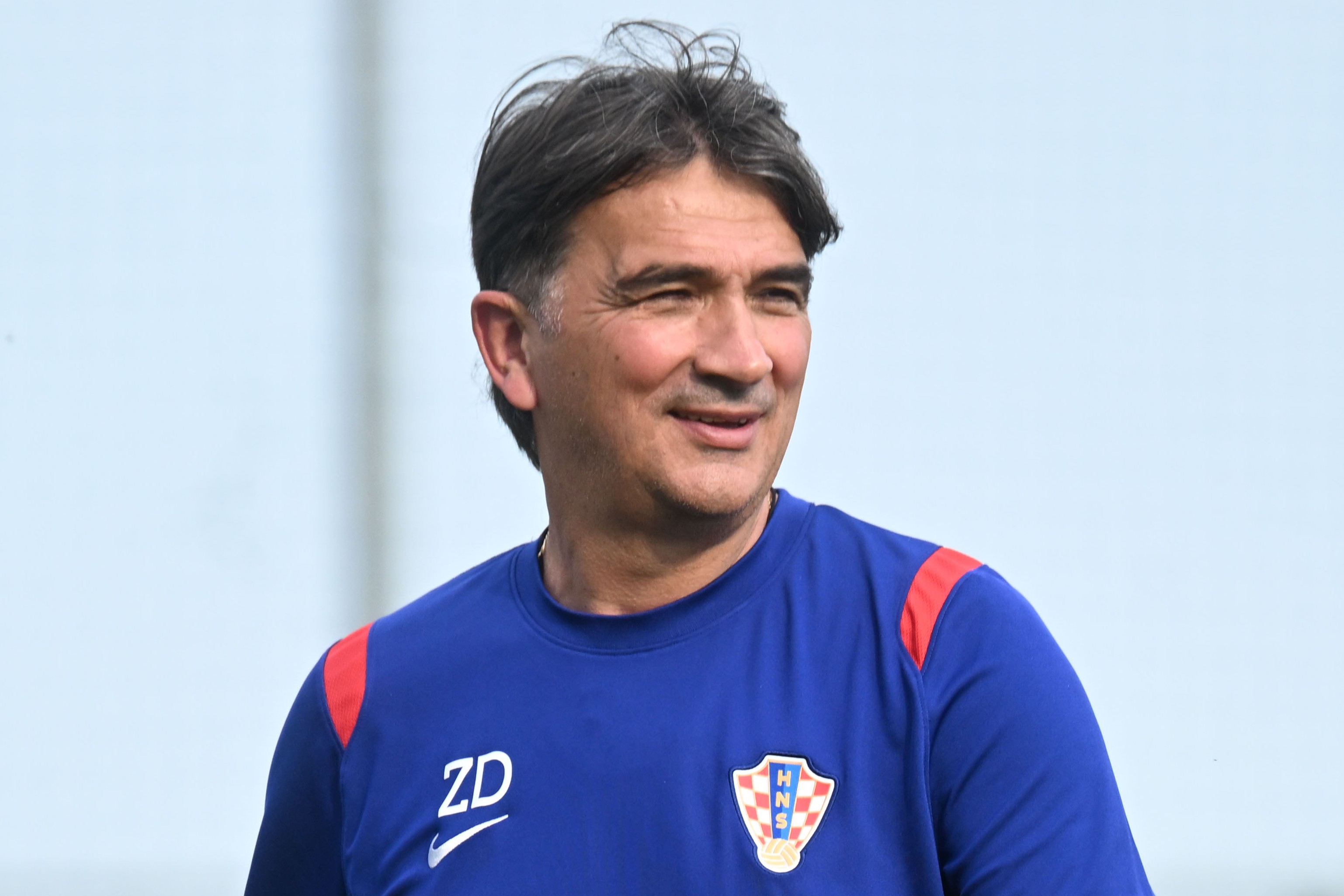
Zlatko Dalić has managed the Croatia national team since 2017, making him the longest-serving coach in the programme’s modern era. His record requires no embellishment: a World Cup final, a World Cup third-place finish, and a Nations League final across eight years in charge. Before taking over the national team, he managed clubs in Croatia, Albania and the Middle East, including Al-Ain, with whom he reached the 2016 AFC Champions League final. The appointment in 2017 came with an explicit condition — qualify for the 2018 World Cup or face review. What followed was the greatest period in Croatian football history.
His preferred system is a 4-3-3 or 4-2-3-1 built around midfield control and defensive discipline. Croatia do not press relentlessly — they organise into a compact shape, win the ball back through positional intelligence rather than intensity, and rely on Modrić’s distribution to create the spaces that Kramarić and the wide players exploit. Against stronger opponents, this pragmatism can produce results that higher-ranked sides fail to achieve. Against weaker opposition that defends deep, Croatia occasionally struggle to break through, as the Euro 2024 group stage demonstrated.
The tactical challenge for 2026 is managing a squad in transition. The veterans who have driven the system for eight years are at or near the end of their international careers. The younger midfielders — Baturina, the Sučić cousins — are talented but unproven at tournament level. Dalić’s ability to integrate them without destabilising the system while simultaneously protecting Modrić’s minutes will define how far Croatia go.
Source: x.com/HNS_CFF
Croatia Fixtures (Match Schedule) at 2026 World Cup
Strengths: Elite midfield control when Modrić and Kovačić are both fit and operating together; Gvardiol’s defensive authority and ball-carrying ability from deep; Livaković’s penalty shootout record and big-match composure; a collective tournament mentality built across two consecutive deep runs; set-piece delivery of genuine quality through Modrić, Perišić and Pašalić.
Weaknesses: Heavy dependence on three players — Modrić, Kovačić and Gvardiol — who are all carrying fitness concerns into the tournament; absence of a world-class, physically dominant central striker capable of winning matches on his own; recovery pace at full-back that can be exposed by teams with quick wingers; the squad’s overall depth drops sharply beyond the starting eleven; Euro 2024 raised legitimate questions about the midfield’s pressing capacity against modern high-intensity sides.
Group L Overview:
England (FIFA Ranking: 4th) — The group’s toughest opponent and Croatia’s opening match. England arrive ranked fourth in the world with one of the tournament’s deepest squads. Croatia beat England in the 2018 World Cup semi-final — a result that still resonates. But England have evolved significantly, and a Croatia side managing injury concerns cannot rely on nostalgia. This match will define the tone of Croatia’s entire group campaign. Match 1: June 17, 22:00 CEST.
Ghana (FIFA Ranking: 74th) — A team Croatia should expect to beat. Ghana are ranked 63 places below Croatia and lack the individual quality to trouble a full-strength Vatreni side across 90 minutes. This is the match that should deliver the three points that underpin Croatia’s group-stage strategy, but overconfidence in a compact defensive environment has been Croatia’s undoing before. Match 2: June 23, 22:00 CEST.
Panama (FIFA Ranking: 33rd) — A physical, well-organised side that will make life difficult without having the quality to threaten Croatia consistently. Panama’s physicality could test Croatia’s aging midfield over 90 minutes, particularly in heat and humidity. Three points from this match, combined with any positive result against England, should be enough for progression. Match 3: June 27, 23:00 CEST.
Croatia Odds & Best Bets for the 2026 World Cup: Value Picks & Predictions
The market prices Croatia as a genuine contender — ranked between the top favourites and the second tier of tournament hopefuls. Those odds deserve careful examination because Croatian tournament football consistently outperforms the statistical inputs that bookmakers use to calibrate pre-tournament markets.
| Market | Odds | Bookmaker | Value? |
|---|---|---|---|
| Win the Tournament | 80.00 | Sapphirebet | Speculative |
| Reach the Final | 30.00 | Sapphirebet | Yes |
| Reach Semi-final | 13.00 | Sapphirebet | Yes |
| Reach Quarter-final | 5.50 | Sapphirebet | Yes |
| Reach Round of 16 | 2.50 | Sapphirebet | Medium |
Understanding the market: The Round of 16 line at 2.50 implies a roughly 40% probability of advancing from Group L. For a team ranked 11th in the world that has qualified from every group stage since 2014 except a single poor Euro 2024 campaign, that implied probability feels too low. Croatia have the individual quality, the tactical experience and the group-stage draw to progress — provided the fitness concerns resolve. The market appears to be discounting Croatia partly because of the injury picture and partly because of the Euro 2024 disappointment, both of which are reasonable considerations but together may be creating an overly pessimistic baseline.
Bet 1: Croatia to Reach the Quarter-finals — 5.50 (Value Bet)
This is the headline pick and the market where the gap between implied and realistic probability is largest. The 5.50 implies roughly an 18% chance of reaching the last eight. Croatia have done exactly that — or better — in two of the last three World Cups. The path from Group L to the quarter-finals requires qualifying from a group that contains Ghana and Panama alongside England, then winning one Round of 16 match. For a team of Croatia’s experience, knockout football intelligence and set-piece quality, that is entirely achievable. The risk is the fitness question — if Kovačić and Gvardiol are not fully available, the defensive and midfield architecture is compromised. But at 5.50, the odds already incorporate significant uncertainty. This is the bet that offers the best risk-to-reward ratio in Croatia’s market.
Bet 2: Croatia to Qualify from Group L — 2.50 (Medium-Value Bet)
The 2.50 is surprisingly generous for a team of Croatia’s pedigree facing Ghana and Panama alongside England. Even accounting for the England opener, Croatia should accumulate enough points from the other two matches to advance. Their qualifying campaign’s defensive record — four goals conceded across eight matches — suggests the structure is sound, and Kramarić’s six qualifying goals confirm the attack is functional. This is not a high-odds bet, but the 40% implied probability feels meaningfully below what Croatia’s quality and experience would suggest in this specific group. It works best as part of an accumulator rather than a standalone wager.
Bet 3: Croatia to Reach the Semi-finals — 13.00 (Value Bet)
At 13.00, reaching the semi-finals — something Croatia have done in two of their last three World Cup appearances — is priced as a low-probability outcome. The implied probability of roughly 8% underestimates a team with this tournament pedigree and this knockout mentality. Croatia’s extra-time wins, penalty shootout record under Livaković and ability to grind results when the system functions make them dangerous in single-elimination matches against any opponent. For bettors willing to accept tournament-length variance, this line offers genuine value relative to the historical base rate. The scenario that makes it win: qualify from Group L, draw a manageable Round of 16 opponent, then produce the kind of knockout performance that defines this generation’s legacy.
Bet 4: Kramarić to Score Anytime in the Group Stage — (Safe Bet)
Six qualifying goals, 36 international strikes and a role that places him in exactly the half-space positions where he is most dangerous. Croatia face Ghana and Panama in two of their three group matches — opponents that, on paper, should be creating situations where Kramarić receives the ball in threatening areas. His consistency as a scorer across the last three years of international football makes this a reliable lower-odds option for accumulators.
Risk factors across all bets: Every positive outcome for Croatia is conditional on Modrić, Kovačić and Gvardiol all being fit and available. The difference between a healthy Croatia and one missing any two of those three is substantial enough to move the realistic probability of quarter-final progression from plausible to marginal. Monitor fitness news in the weeks before June 11 — it is the most important variable in this entire market.
Croatia Prediction for the 2026 World Cup: Can They Qualify from Group?
The most realistic scenario is Croatia qualifying from Group L in second place, with six points — a draw or narrow defeat against England, followed by wins over Ghana and Panama. First place is possible if they beat England, which Croatia’s history against them suggests should never be discounted. The 2018 semi-final, where they came from behind to win, is the reference point.
Beyond the group stage, the quarter-final represents the realistic ceiling, with a semi-final run possible if the fitness picture clears and the draw is reasonably kind. Reaching the final — as they did in 2018 — would require everything to go right: full fitness, a favourable knockout bracket and the kind of momentum that only tournament football can generate. At 30.00, that market contains speculative value for the optimistic bettor.
The defining match of Croatia’s group stage is the England opener on June 17. A positive result there — and Croatia will approach it believing they can win, not just survive — sets the group wide open. A defeat forces Dalić to manage points pressure across two matches where Croatia should be favourites but cannot afford complacency.
What is certain is that this team will not simply participate. This is Modrić’s farewell. Dalić has never managed a tournament without ambition. The Vatreni have reached the podium in two consecutive World Cups. They will be dangerous until they are eliminated.
Croatia 2026 World Cup FAQ: Predictions, Odds & Key Questions
Will Croatia qualify from Group L at the 2026 World Cup?
Yes, in most realistic scenarios. Croatia have the quality to beat Ghana and Panama, and a draw against England would be enough to advance comfortably. The group-stage exit risk exists only if the major fitness concerns — Kovačić, Gvardiol and Modrić — are not resolved before June.
What are the best bets on Croatia at the 2026 World Cup?
Croatia to reach the quarter-finals at 5.50 offers the strongest risk-to-reward ratio. The semi-final line at 13.00 holds value for bettors comfortable with tournament-length variance. Both are supported by Croatia’s historical record of outperforming their implied market probability in knockout football.
Who is Croatia’s main goalscorer?
Andrej Kramarić leads the active squad with 36 international goals and six qualifying strikes. Ivan Perišić, Croatia’s second all-time scorer with 38 goals, remains a threat from wide positions. Ante Budimir leads the attacking line but the goal-scoring is distributed across multiple players rather than concentrated in a single striker.
Is this Luka Modrić’s last World Cup?
Yes. At 40 years old and with 194 caps, Modrić has confirmed that the 2026 tournament is his last major international competition. He said the same before Euro 2024, but the current consensus — within the squad, the federation and Modrić himself — is that this is genuinely the farewell tournament.
Can Croatia win the 2026 World Cup?
Possible at 80.00, but not a bet with strong analytical foundations. Croatia’s ceiling, based on squad depth and the fitness concerns surrounding key players, is more realistically the semi-finals. They are dangerous in knockout football but lack the consistent attacking depth of the tournament’s top four or five favourites.
Who is Croatia’s most important player at this World Cup?
Luka Modrić remains the creative heart, but Mateo Kovačić’s fitness may be the single most important variable. Without Kovačić, the midfield balance changes significantly and Modrić is more exposed physically. Gvardiol’s availability is equally critical at the back.
What is Croatia’s biggest strength at the 2026 World Cup?
Collective tournament experience and knockout football mentality. No team in this group — and few in the tournament — has the institutional knowledge of winning elimination matches under pressure that this Croatian generation has accumulated across two World Cup podium finishes.
What is Croatia’s main weakness?
The reliance on three players who are all carrying fitness concerns, combined with the absence of a consistently dominant central striker. When Croatia need a goal from open play in the final twenty minutes of a tight knockout match, the options are limited compared to the top-ranked sides they would face in the latter stages.
Is Croatia a Good Bet at the 2026 World Cup?
Croatia are one of the most analytically compelling betting propositions at this tournament — not because they are likely to win it, but because the market consistently underestimates their capacity to progress through knockout rounds. The quarter-final line at 5.50 and the semi-final line at 13.00 both offer genuine value relative to historical base rates for a team of this experience and tactical intelligence. Bet on the journey, not the destination — and back Croatia to make the journey longer than the market expects.