
There are more than just dramatic nights under the lights, last-second winners, and memorable comebacks in the UEFA Champions League. It’s also about playing off the field in UEFA Champions League Fantasy Football for millions of football fans around the world. The official game is a mix of strategy, football knowledge, and a little luck. It rewards people who can predict form, figure out schedules, and stick to budgets.
This guide breaks down the 2025–26 season in detail, including rules, tactics, Matchday 1 picks, mistakes to avoid, and tips from experts. This is everything you need to get to the top of the Fantasy Premier League leaderboards, whether you’re an experienced player or just starting to learn about Europe’s biggest club tournament.
What Is UEFA Champions League Fantasy?
The UEFA Champions League Fantasy game allows you to manage a virtual squad of Europe’s elite footballers. Unlike Fantasy Premier League, the game reflects the unique rhythm of the Champions League: midweek fixtures, knockout jeopardy, and constant rotation risks.
- Squad size: 15 players – 2 goalkeepers, 5 defenders, 5 midfielders, 3 forwards.
- Budget: €100 million for the group stage; it increases to €105 million after the league phase.
- Club limit: Maximum 3 players per club during the group phase. This expands as the tournament progresses.
- Transfers: 2 free transfers per group-stage matchday. During knockouts, this rises to 3–5 depending on the round.
- Wildcards: Two windows of unlimited transfers – before the Round of 16 and after the league phase.
- Captaincy: You can change your captain mid-matchday if your first choice disappoints, but doing so disables automatic substitutions.
The format rewards not only star players but also smart picks from lesser-known teams that can rack up points in favorable fixtures.
How the 36-Team Format Changes Fantasy Strategy
With 36 teams in the league phase instead of the usual 16 teams in the group stage, the 2025–26 season marks the start of a new era. Instead of playing six games against other teams in the same four-team group, each club now plays eight games against a range of teams.
It’s good and bad for fantasy managers to deal with this change. On the one hand, more games mean more chances to score points, which gives star players more chances to shine. On the other hand, coaches have to handle more games in the Champions League and busy domestic schedules, which increases the risk of rotation. Finding good matchups across eight games can make the difference between an average team and a winning one, so fixture planning is more important than ever. The bigger field also means there are more players to choose from, as there are now more teams from different leagues. This gives management more options for differential picks.
It’s important to get used to these changes quickly; people who treat the league phase like the old group stage may fall behind those who accept its own rhythm.
Scoring System Overview
- Goalkeepers & Defenders:
- Goal: 6 pts
- Clean sheet: 4 pts
- Ball recoveries: +1 pt per 3 recoveries
- Saves (goalkeepers): +1 pt per 3 saves
- Midfielders:
- Goal: 5 pts
- Assist: 3 pts
- Ball recoveries: +1 pt per 3 recoveries
- Forwards:
- Goal: 4 pts
- Assist: 3 pts
- All players:
- Player of the Match: 3 pts
This system makes midfielders and defenders particularly valuable compared to other fantasy games, as they can rack up points through multiple metrics.
Building the Perfect Fantasy Team
The art of squad-building in fantasy soccer Champions League lies in balance. Overspending on attacking stars will leave your defense and bench exposed, while focusing too much on value picks risks missing out on explosive hauls from marquee players.
Budget Allocation Strategy
- Forwards: Secure at least one premium forward (think Erling Haaland or Kylian Mbappé) alongside a mid-range striker and a budget option.
- Midfielders: Mix creators and goalscorers. Attacking midfielders often score as much as forwards due to the 5-point goal rule.
Defenders: Prioritize full-backs and wing-backs from dominant teams – clean sheets + attacking returns. - Goalkeepers: Consider a premium option from a defensive powerhouse paired with a budget pick who rotates well.
Rotation Awareness
UEFA Fantasy allows manual substitutions. That means players scheduled to play later in the week can be left on your bench and swapped in if earlier picks underperform. Planning around the matchday split is crucial.
Rotation Risks and How to Handle Them
Rotation has long been a headache for Champions League Fantasy managers. Clubs with deep squads, such as Pep Guardiola’s Manchester City or Real Madrid, are especially prone to resting stars when the stakes are lower.
The challenge is that you never know when your captain or premium forward might be benched. While there is no foolproof solution, savvy managers can take steps to soften the impact.
One approach is pairing players from the same club in different positions – for instance, combining Erling Haaland’s goalscoring power with Josko Gvardiol’s defensive solidity. If one is rotated, the other may still deliver points.
Another strategy is to avoid concentrating too heavily on a single club, ensuring that one disappointing lineup does not sink your entire team. And since UEFA Fantasy allows manual substitutions, managers can use later kick-offs as a safety net, leaving players on the bench who can be brought in if earlier picks underperform.
Rotation cannot be eliminated, but careful planning can keep it from ruining a matchday.


Champions League Fantasy Picks: Matchday 1 Targets
The 2025/26 league phase kicks off on 16 September 2025, with 36 teams competing in the expanded format. Here are standout options for Matchday 1 based on fixtures, form, and ownership value.
Forwards
- Erling Haaland (Manchester City) – The most reliable source of goals in European football. Facing a favorable opening fixture, he’s a must-own.
- Robert Lewandowski (Barcelona) – Still prolific, particularly against weaker opposition in early group games.
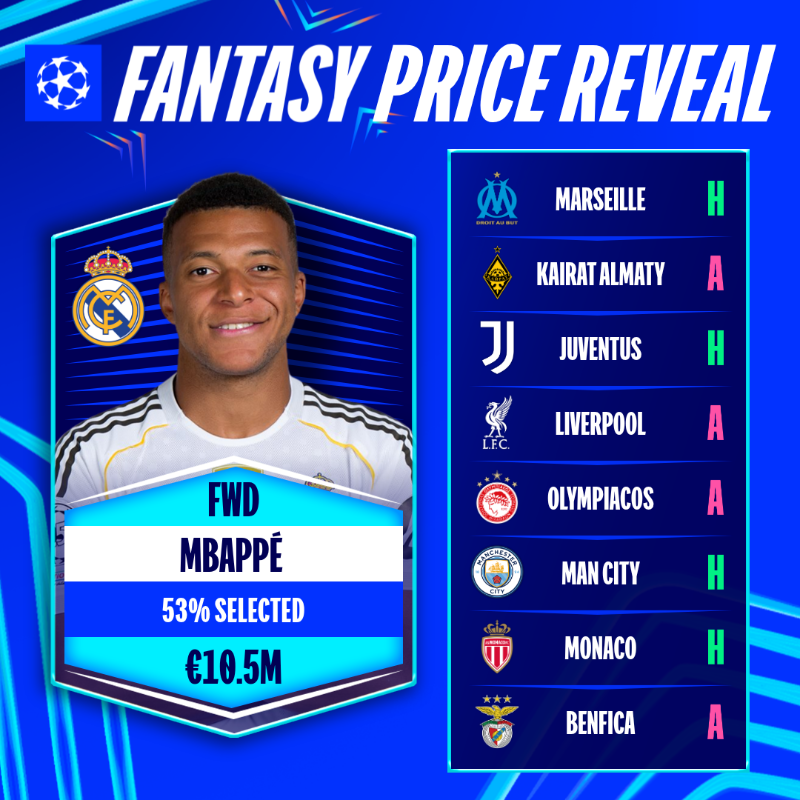
- Kylian Mbappe (Real Madrid) – one of the leaders of Xabi Alonso’s renewed team. He can bring you points not only for goals, but also for assists.
Midfielders
- Jude Bellingham (Real Madrid) – Central to everything Madrid do, offering both goals and assists.
- Raphinha (Barcelona) – the leader of the Catalan giants, who in the 2024/2025 season scored 13 points based on the sum of “goal + assist”.
- Khvicha Kvaratskhelia (PSG) – A differential pick with explosive potential against defensively weak teams.
Defenders
- Denzel Dumfries (Inter Milan) – Offers attacking returns from full-back while contributing to clean sheets.
- Josko Gvardiol (Manchester City) – Strong clean sheet potential, and occasional attacking involvement.
- Achraf Hakimi (PSG) – A wing-back who thrives in attack, particularly valuable in favorable fixtures.

Source: x.com/AchrafHakimi
Budget Enablers
- Aleksander Isak (Liverpool, Forward) – He hasn’t played a single game this season yet, but he’s one of the top talents in modern football. Keep an eye on him before his price tag increases.
- Tijjani Reijnders (Man City, Midfielder) – Already in his debut match for the “city” he showed that he came to the club seriously and for the long term. He could become the X-factor for City in the new season.
- Diogo Costa (FC Porto, Goalkeeper) – Affordable shot-stopper with potential for both saves and clean sheets.
Fantasy Tips & Winning Strategies
1. Target Fixtures Aggressively
With the new league-phase format (each team plays 8 fixtures), maximizing favorable matchups is crucial. Teams like City, Bayern, and Madrid will dominate possession, creating more opportunities for fantasy returns.
2. Don’t Ignore Defenders
Full-backs and wing-backs from strong teams are almost midfielders in disguise. Dumfries, Hakimi, and Davies often deliver attacking points alongside clean sheets.
3. Captaincy Rotation
Exploit the ability to switch captains mid-matchday. If Haaland blanks on Tuesday, hand the armband to Mbappé on Wednesday. This flexibility is a huge edge over traditional FPL.
4. Manage Transfers Wisely
Avoid knee-jerk transfers. Fixtures come fast, and saving a transfer for tougher knockout stages is often wiser than chasing one explosive score.
5. Play Wildcards Strategically
Use one after the group stage to reset your squad with the €5 million budget increase. The second is best saved for before the Round of 16, when rotation risks increase.
Weekly Preparation & Matchday Routines
Winning managers are meticulous about details:
- Lineups: Monitor team news closely. UEFA and club websites often release hints pre-match.
- Form checks: Track domestic league performances. A striker struggling in domestic games is unlikely to suddenly explode in Europe.
- Rotation awareness: Elite clubs juggle intense schedules; managers often rest key players against weaker opposition.
Common Mistakes to Avoid
- Stacking from one club: A bad result can sink your entire team. Spread risk across leagues and clubs.
- Ignoring substitutions: The manual substitution feature is your secret weapon. Always plan your bench order.
- Overlooking defenders and goalkeepers: Attackers grab headlines, but clean sheets and save points are often the foundation of consistent scoring.
- Chasing last week’s points: Past performance doesn’t guarantee future returns, especially with rotation-prone squads.
Prizes and Community Leagues
While many fans play Champions League Fantasy for bragging rights alone, UEFA has raised the stakes with an impressive set of prizes that add real-world rewards to the virtual competition. At the very top, the ultimate prize awaits the manager who finishes the season as the global number one: a trip for two to the 2027 UEFA Champions League final, with flights and accommodation included, along with a brand-new PlayStation®5. It is the kind of once-in-a-lifetime experience that gives every matchday added meaning.
The runners-up are not left empty-handed. Second place on the overall leaderboard is rewarded with a team jersey of choice from any UEFA competition participant, while third place earns an official match ball designed for this season’s Champions League, as well as a copy of EA Sports FC 26. These prizes ensure that even those just shy of the top spot still walk away with tangible reminders of their achievement.
There are also rewards spread out over the season. Every day, the manager with the most goals wins a PlayStation®5, so each round is like a little battle. There is also a big prize for the league phase. The winner at the end of this stage gets to go with a friend to the 2026 Champions League final in Budapest, where they will stay and get a PlayStation®5. The knockout rounds are also tough, and the boss with the most points at the end of that stage wins another PlayStation®5.
Besides the official prizes, the community part of the game is what makes it great. In global leagues, players can test their skills by going up against tens of thousands of managers from around the world. They can also make their own private leagues with friends, coworkers, and fan groups. Every choice you make about your lineup has more value because of the competitive community rivalries and the big prizes. This supports the idea that Champions League Fantasy is both a game of competition and friendship.
Using the UEFA Fantasy App and Website
For newcomers, it is easy to overlook how much functionality the official UEFA Fantasy platform provides. Both the app and the website offer tools that can significantly improve a manager’s chances of success. Real-time substitutions, for example, allow you to replace underperforming players with those yet to feature later in the week, while captaincy can be switched after the first round of matches if your initial choice disappoints.
Notifications are another underused asset, providing timely alerts when official lineups are released and giving managers a chance to react before deadlines pass. Beyond team management, the platform also makes it easy to join global competitions or set up private leagues with friends, adding a social layer that keeps the game engaging week after week.
In short, the UEFA app and website are not just entry points to the game but essential tools for staying competitive throughout the season.
Source: x.com/ChampionsLeague
Champions League Fantasy FAQs
When should I use my wildcard?
Ideally after the group stage and again before the Round of 16.
How are eliminated players handled?
They no longer score, so replace them with active players immediately.
What happens if I don’t use my free transfers?
You can carry one forward, but never more than that.
Is captaincy change unlimited?
No. Once you switch, you can’t switch again within the same matchday.
Final Words from TipsGG Team

The UEFA Champions League Fantasy Football 2025/26 is set to be one of the most competitive seasons yet. With a bigger structure, a €105 million budget after the groups, and a huge pool of top players to choose from, teams will need to plan their schedules, make smart substitutions, and build teams that are balanced.
Names like Haaland, Bellingham, Isak, and Reijnders stand out as must-picks for the first matchday. But as the season goes on, the difference between casual players and real contenders will be their ability to change and plan ahead.
Fantasy is more than just a game; it’s how Champions League fans get involved with the trip. Set up your band, play smart, and enjoy the biggest stage in Europe in a whole new way.