
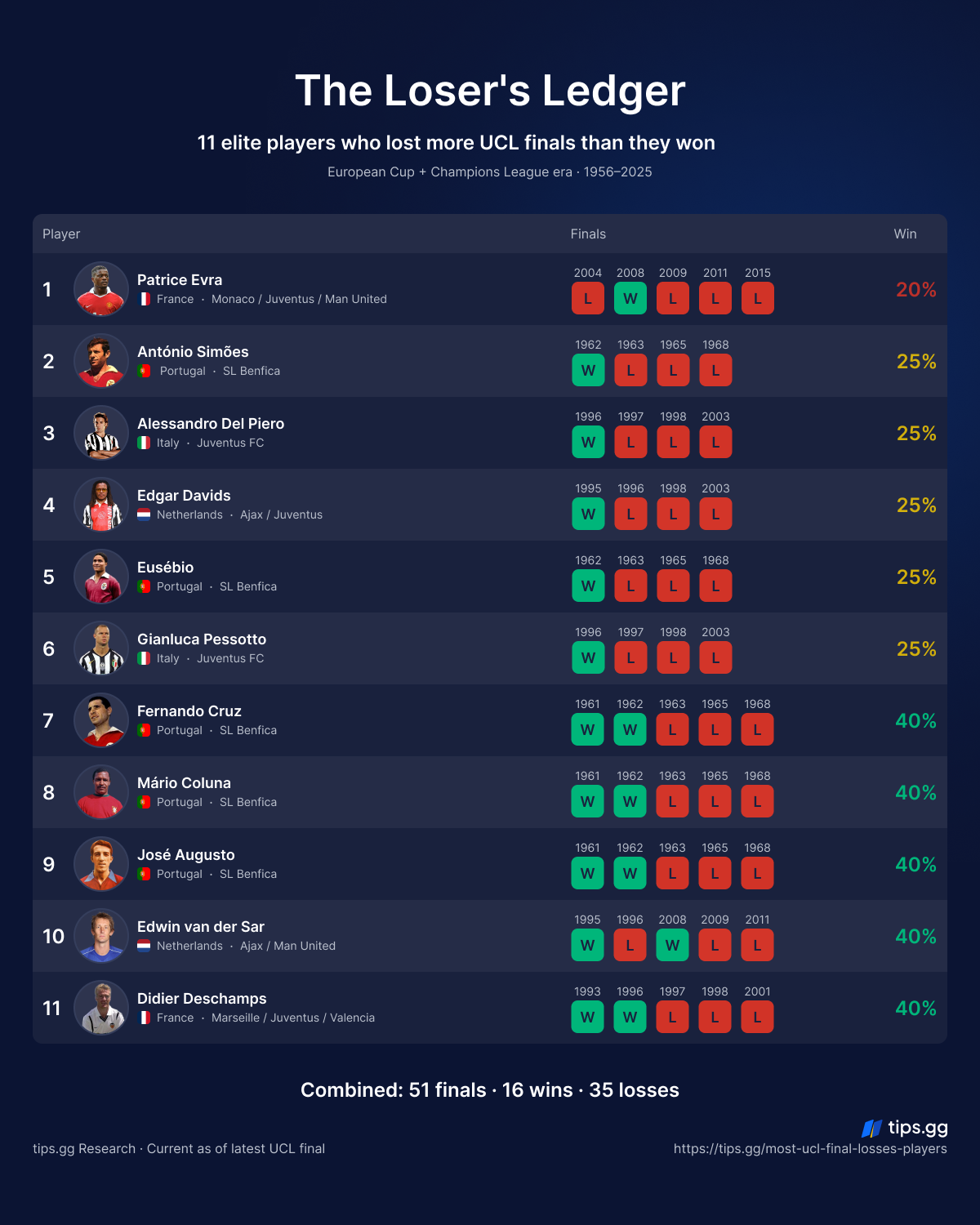
They reached the biggest stage in club football repeatedly, yet kept leaving empty-handed. Meet the 11 players who lost more UCL finals than they won.
Reaching a Champions League final once is a career achievement most professionals never tick off. Reaching it four or five times and still walking away a loser more often than a winner? That is a peculiar kind of torment — one that no trophy cabinet can quite erase. Across the long history of European club football’s biggest night, a handful of players have done exactly that: appeared on the grandest stage repeatedly, tasted defeat more often than glory, and still remained part of the conversation decades later.
This is not a list of failures. Quite the opposite. To qualify for this uncomfortable roll call at TipsGG, you had to be elite enough to keep reaching finals. You had to matter. The cruel irony is that mattering, in this case, came with a receipt.
Who Counts as a “Final Loser”?
The criteria here are simple and merciless: four or more appearances in UEFA Champions League (or European Cup) finals, with a winning percentage below 50%. No rounding up. No sympathy deductions for quality of opponent or freak circumstances. The numbers are what they are.
Eleven players meet the threshold. Three clubs dominate the list: SL Benfica, Juventus FC, and Ajax Amsterdam, which tells you something interesting about how European football history actually works. Dynasties reach finals. Sometimes they just do not win enough of them.
Our data methodology
In compiling this ranking and maintaining the statistical integrity of the list, we adhered to a precise criteria for inclusion of data, with an eye on consistency across the lengthy history of the competition. Our research includes all European Cup finals 1955-1992 and every UEFA Champions League finals from 1992 until the present day. A player had to be named in the squad for the final to be included as a finalist. Players that were not in the squad for the final were not counted in this analysis. The stats have been painstakingly assembled from a number of credible sources, including the official UEFA.com archive, RSSSF, Transfermarkt, ESPN Stats and other sources. All data shown in the table is based on the results and player appearances up to the cut-off date: 15 May 2026.
The Full Picture: Stats at a Glance
| Player | Nationality | Club(s) | Finals | Wins | Dates | Win % |
| Fernando Cruz | Portugal | SL Benfica | 5 | 2 | 1961, 1962, 1963, 1965, 1968 | 40.0% |
| Edwin van der Sar | Netherlands | Ajax / Man United | 5 | 2 | 1995,1996, 2008, 2009, 2011 | 40.0% |
| Patrice Evra | France | Monaco / Juventus / Man United | 5 | 1 | 2004, 2008, 2009, 2011, 2015 | 20.0% |
| Mário Coluna | Portugal (b. Mozambique) | SL Benfica | 5 | 2 | 1961, 1962, 1963, 1965, 1968 | 40.0% |
| José Augusto | Portugal | SL Benfica | 5 | 2 | 1961, 1962, 1963, 1965, 1968 | 40.0% |
| Didier Deschamps | France | Marseille / Juventus / Valencia | 5 | 2 | 1993, 1996, 1997, 1998, 2001 | 40.0% |
| António Simões | Portugal | SL Benfica | 4 | 1 | 1962, 1963, 1965, 1968 | 25.0% |
| Alessandro Del Piero | Italy | Juventus FC | 4 | 1 | 1996, 1997, 1998, 2003 | 25.0% |
| Edgar Davids | Netherlands (b. Suriname) | Ajax / Juventus | 4 | 1 | 1995, 1996, 1998, 2003 | 25.0% |
| Eusébio | Portugal (b. Mozambique) | SL Benfica | 4 | 1 | 1962, 1963, 1965, 1968 | 25.0% |
| Gianluca Pessotto | Italy | Juventus FC | 4 | 1 | 1996, 1997, 1998, 2003 | 25.0% |
The players at 25% are, mathematically, the most battered. One win from four tries. Imagine doing that in a career and still being remembered as a legend of the game — which every single one of them is.
The Benfica Bloc: Elegance That Kept Falling Short
Five of the eleven players — Cruz, Coluna, Augusto, Simões, and Eusébio — spent their careers at SL Benfica during the club’s golden era of the 1960s and early 1970s. They reached five European Cup finals in that period, winning two (1961 and 1962). Three defeats followed, and the wait for a third continental title has now stretched over six decades.
Eusébio is the most famous name on this list to most football fans. The “Black Panther” was one of the best players in the world during his peak years, and yet he ended his career with a 25% finals win rate in European competition. His 1968 European Cup final against Manchester United at Wembley remains one of the most emotionally raw images in European football history. In the closing stages of normal time, with the score 1-1, Eusébio bore down on United’s keeper Alex Stepney and unleashed a blistering shot, only to see Stepney make a brilliant point-blank save. Instead of showing disappointment, Eusébio applauded the keeper and patted him on the back in a memorable gesture of sportsmanship. Benfica eventually lost the match 4-1.
Mário Coluna captained that same Benfica side with authority and craft. A Mozambican-born midfielder who became the heartbeat of the Portuguese club, Coluna played in five finals, won two, and watched the other three slip away. José Augusto and Fernando Cruz share identical numbers: five finals, two wins, three losses. Quiet heroes of a team that was extraordinary but rarely fortunate when it mattered most.
António Simões, the smallest man in most rooms he entered, played with ferocious intensity. Four finals, one win. His story is a compressed version of the whole Benfica tragedy: brilliant, dogged, and ultimately denied.
Juventus: The Factory of Beautiful Heartbreak
If Benfica defined the 1960s version of this curse, Juventus invented its modern form. The Old Lady has reached more Champions League finals than almost any club since the competition’s rebranding in 1992 — and won fewer than anyone would expect. Three players on this list owe their uncomfortable statistics entirely or partly to their time in Turin.
Alessandro Del Piero is the name that carries the most emotional weight here. Eleven seasons as Juventus captain, one of the most technically gifted strikers Italy has ever produced, and a record of one win from four European Cup finals. The 1996 triumph in Rome against Ajax is his. The 1997 loss to Borussia Dortmund, the 1998 defeat by Real Madrid, the 2003 penalty shootout loss to Milan at Old Trafford — those are the ones that linger.
Gianluca Pessotto, a full-back defined by selfless discipline rather than individual flair, shared the same journey. Four finals at Juventus, the same solitary win in 1996. His story is the story of an entire generation of Bianconeri who were magnificent but somehow always came second on the biggest nights.
Didier Deschamps: The Collector With a Complicated Ledger
No player on this list had a career more varied in its European drama than Didier Deschamps. He appeared in five finals across three different clubs, winning with Marseille in 1993 and with Juventus in 1996, then losing with Juventus twice more and once with Valencia.
Here is a specific kind of irony: Deschamps is now the France national team manager and a World Cup winner as both player and coach. His reputation as a winner is ironclad. And yet his Champions League finals record sits at 40%, because football giveth and taketh away without asking anyone’s permission. The Valencia chapter is particularly strange — he joined the Spanish club late in his career and promptly reached the 2001 final, where they lost to Bayern Munich on penalties.
Edgar Davids: Four Finals, One Medal, Zero Regrets (Probably)
Edgar Davids is the rare player who connects two of the clubs most represented on this list. He won the 1995 European Cup with Ajax as a young man bursting with energy, then followed that with three more finals appearances — two with Juventus, one more with Ajax — winning none of them. His lifetime record: four finals, one win.
What makes Davids interesting in this context is temperament. He was never a player who seemed weighed down by near-misses in the way some others visibly were. His game was physicality and drive; whether he carried the psychological weight of these defeats privately is another matter. The numbers, in any case, are unsparing.
Edwin van der Sar and Patrice Evra: The Modern Entries
The two most recent players on the list, van der Sar and Evra, represent Manchester United’s Champions League years under Sir Alex Ferguson.
Edwin van der Sar reached five European Cup/Champions League finals in total — two with Ajax in the 1990s (win in 1995, loss in 1996) and three with Manchester United. Among them were the dramatic 2008 final, which United won on penalties against Chelsea, and the 2009 final in Rome, lost to Barcelona. His fifth and final appearance came in the 2011 Champions League final at Wembley, where United lost 3-1 to Barcelona. By a twist of fate, that match was also his last for the club.
Patrice Evra has the single worst winning percentage on the entire list at 20%, and it is partly because his path to finals was remarkably consistent but his luck was not. One win from five appearances. He was part of the United squad that beat Chelsea in 2008 and lost to Barcelona twice (2009 and 2011). His stints at Monaco and Juventus added further final appearances without adding winners’ medals. A single win from five shots at the title is, statistically, the harshest outcome on this list.
Two Patterns Worth Noting
A few things stand out when you look at this group collectively.
- Club concentration: Benfica (five players), Juventus (three players, with Deschamps and Davids also spending time there), and Ajax (van der Sar and Davids) account for almost the entire list. These were the clubs that kept reaching finals, which meant their core players kept accumulating appearances — and, inevitably, losses.
- Nationality concentration: Five of the eleven are Portuguese, four are from Benfica’s core 1960s squad alone. Three are French, two are Dutch. The list is a snapshot of European football’s geographical power during specific eras.
What Does a 25% Finals Record Actually Mean?
Something people rarely say out loud: losing four finals and winning one is not a mark of failure. It is a mark of recurring excellence. Players who appear in one final are common. Players who appear in four are rare enough to be memorable. Players who appear in five, like van der Sar or Evra or Cruz or Coluna or Augusto or Deschamps, are genuinely exceptional in terms of career trajectory.
The stigma the headline refers to is a constructed one. It is the gap between what the public expects from great players (constant triumph) and what football actually delivers (frequent, brutal randomness). Finals are decided by margins. A penalty saved. A deflection. A referee’s call. Alessandro Del Piero losing three of four finals does not say anything fundamental about his quality as a footballer. It says something about how tight European Cup finals tend to be.
That said — the numbers are real, and they sting. Ask anyone who was there.
Key Facts at a Glance
Here is a quick summary of the standout figures from the full dataset:
- Most finals appearances: Fernando Cruz, Edwin van der Sar, Patrice Evra, Mário Coluna, José Augusto, and Didier Deschamps — all with 5
- Lowest winning percentage: Patrice Evra at 20% (1 win from 5 finals)
- Players with 25% win rate: Simões, Del Piero, Davids, Eusébio, Pessotto — one win from four finals each
- Most represented club: SL Benfica (5 players)
- Players on the list to win finals at two separate clubs: Didier Deschamps (Marseille 1993, Juventus 1996), Edwin van der Sar (Ajax 1995, Man Utd 2008)
FAQ
Who has the worst Champions League finals record on this list?
Patrice Evra, with a 20% winning percentage — one win from five final appearances across Monaco, Juventus, and Manchester United.
Why does Benfica appear so many times on this list?
SL Benfica were dominant in European football during the 1960s and early 1970s, reaching five European Cup finals in that era. Their core squad of that period naturally accumulates multiple final appearances. They won in 1961 and 1962 but lost the other three, which dropped every long-serving player below the 50% threshold.
Does this list include the European Cup era, or only the Champions League era?
It includes the full history of the competition, from the European Cup through to the rebranded UEFA Champions League format. That is why Eusébio, Coluna, and the Benfica players from the 1960s are included.
Is reaching a Champions League final considered an achievement or a failure?
Purely as a statistical matter, reaching a final is an elite achievement. Fewer than 0.5% of professional footballers ever appear in one. The “losers” framing here is intentionally provocative: these players were good enough to reach the biggest game in club football repeatedly. The win rate simply did not follow.
Did any of these players win other major trophies to compensate?
Most of them, yes. Del Piero won Serie A titles, the Intercontinental Cup, and the 2006 World Cup with Italy. Deschamps won the World Cup and Euro as both player and coach. Van der Sar won the Premier League multiple times. Eusébio won numerous Portuguese league titles and the Ballon d’Or in 1965. The Champions League final record is a footnote in otherwise decorated careers.
Which club has produced the most players on this list?
SL Benfica, with five players: Fernando Cruz, Mário Coluna, José Augusto, António Simões, and Eusébio. Juventus follow with four (Del Piero, Pessotto, Davids, and Deschamps, the last of whom also appeared in finals with Marseille and Valencia).