 Frokat
Picking out a new champion, no matter how similar they are to your existing main pick, is oftentimes a daunting task. So daunting, in fact, that the majority consensus on the best way to climb the ranks in League of Legends is to never pick up a new champion at all. You’ll see this recommendation pop up all the time, from the players across all ranks – if you want to place as high as you can be, you need to be a one-trick pony.
Playing a single champion for hundreds of games will grant you a lot of insight into its strengths, weaknesses, and roles within the team way faster than changing your pick between every match. In addition to all that, the mental capacity required to pilot your pick won’t be a problem once you let your muscle memory and innate “auto-pilot” do the champion control stuff while you focus on the rest.
But, to quote Dopa, who’s widely regarded as the greatest Solo Queue player of all time, oftentimes rivaling the greatest professional midlaners despite not being a pro himself, “one tricking” inflates your MMR by around 500 points. Yes, he really did say that, even though he’s most known for his impressive mastery of Twisted Fate that allowed him to pretty much one-trick his way into rank 1 Challenger in Korea for 8 years straight.

Jeong “Apdo” Sang-gil is a retired League of Legends esports player, previously mid laner for Anarchy. He is also known as Dopa. He became famous – and infamous at the same time – for two things: his unrivaled skill as a midlane player, and a 1000-year long ban from both the game and its professional scene in Korea after his involvement in Elo boosting trade was uncovered.
The ban did little to deter the handsome rascal from doing the thing he does best – dominating everyone he meets on mid, going toe-to-toe, and even surpassing the likes of Faker, Chovy, ShowMaker, and other talented professional players.
So, if you want to play League of Legends instead of League of Yasuo, expanding your champion pool is a must. Picking up a new champ isn’t as easy as just clicking their portrait in Lobby – assuming you care about winning, of course. So, without further adieu, let’s take a look at some aspects of learning that can make your new champ journey as painless as possible.
The road ahead
Let’s start with the basics. We all know that diving headfirst into Ranked on a new champion should unironically be a bannable offense, so please don’t do that. Playing a few – and, for some highly mechanically intensive champions like Qiyana, a few dozen – Normal games first is pretty much a staple. However, Normal and Ranked games are two entirely different beasts. Not having an imaginary number attached to them makes a surprising amount of difference in the players’ mindsets.
So, if you want to make your champion learning experience as real as it gets without sacrificing the precious ranks on your main account, consider making a secondary account where you can safely practice new champions in Ranked a few ranked tiers below your main. For sure, the time commitment required is pretty immense with League’s anti-smurf requirements, as it takes around a hundred games to reach level 30 that is needed to unlock Ranked Solo Queue… But if you’re really committed, the payoff of your rank being safe and sound as you experiment is well worth it.
The pyramid of champion mastery
With 158 unique champions (at the time I write this, as Renata Glasc release is just around a corner just weeks after Zeri’s introduction), hundreds of abilities, thousands of skills, League of Legends features billions of interactions. And even if we were to focus purely on a single champion’s place in the meta, that number wouldn’t go much lower.

In such an environment, it is important to think big – but start small. Learning to run before you know how to walk would be an insurmountable task – just like creating new build paths for a champion you’ve never played. Doesn’t stop Reddit analysts and stream back-seaters, though.
The basics
Before we even begin learning a new champ, we must outline the reasoning for this decision. It’s entirely fine to play a new champion or even a new role every game, but, as previously mentioned, there’s a reason why this only works if you’re not interested in the competitive ranking aspect of the game.
Hopping around like crazy leaves you no room to improve. With the number of interactions League has – and these interactions also differ from rank to rank, so a Twisted Fate facing a Fizz on mid would look completely different in Gold and in Grandmaster – it would take multiple lifetimes to learn all of them even if you were to entirely devote every single minute of life to playing League.
Perfection is unattainable. But you can come closer to it with every game – provided you have the right mindset.
Champion’s identity
Coming back to the original question – you have to know the answer to the question “Why are you learning a new champion?” And to answer that, you need to know the champion’s core identity. Perhaps the sole reason you want to learn something new is that it counters the nasty, 55% win ratio meta pick you’ve been facing a lot. Or you like champions that offer a lot more agency to make plays around the map, like Aurelion Sol. Or you simple like winning your lane really hard – and then you play AD Carries on top.
With Riot’s role rework back in 2017, the developers have attempted to classify the champion’s roles in a more defined way. That’s how we ended up with “roles within roles”, or the classic roles like Bruisers and Tanks being divided into “Juggernauts” or “Divers”, or “Vanguards” and “Wardens”. While this system is of help to get the general idea of the champion’s role within the team, it is not 100% foolproof.
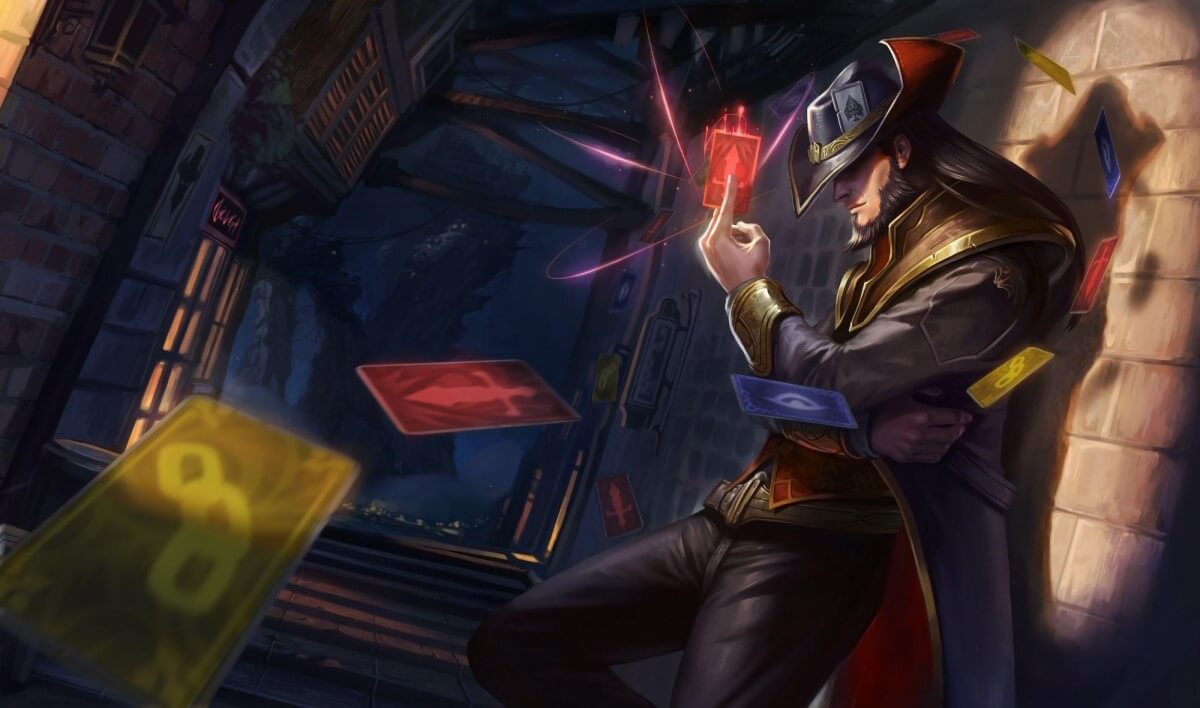
Art by: Riot Games.
For instance, let’s take a look at how this role system defines Twisted Fate. Riot places him in the same role as Brand and Vex as a Burst Mage – but to those who know how these champions actually operate, they’re nothing alike. To go even further, this system doesn’t even make it clear which lane the champion is supposed to be played on! Brand used to be considered a midlane champion ages ago, but his short-range, lack of mobility, very conditional CC, and high cast times made him unfit for the role – but he is still a burst mage, even when played as Support.
So, one should not rely on the League’s official terminology to know a champion’s role in the meta. Besides, it’s not uncommon for champions to be able to adapt their playstyles and perform in different roles if the game situation requires that – with Kayn’s Assassin and Bruiser forms serving as a prime example.
Champion’s power spikes
Directly tying into a champion’s identity, the champion’s power spikes (and power slumps) are a core concept required for the understanding of their role within the game. Most players are familiar with the concepts of “late game hyper-carry” (like Kayle) or “early game lane bully” like Teemo. Power spikes are the same idea, but more detailed: instead of looking at game phases, you analyze the champion’s level or items bought to determine if the environment you’re in is favorable or unfavorable.
A power spike isn’t just a singular event – for example, Yone has an extremely strong interaction with the Lethal Tempo keystone, which makes him one of the strongest champions at level one, all while being a potential mid-to-late game carry. All AD assassins benefit greatly from a Serrated Dirk purchase if bought early. Combine that with, for example, Talon’s incredible level two potential, and you’ll be seeing the game as peaks and valleys of moments of power where you must exploit them, and moments of weakness where you must play more defensively.
Ability identity
Once you’ve figured out which champion you want to learn, here’s where the fun finally starts. Knowing the champion’s core abilities, their interactions, and when and how to use them is 90% of the champion’s mastery. With the League’s Rune system, this also includes them, as well: even though you can look up most popular Rune builds on numerous tools like op.gg, knowing why they’re taken is as important as knowing what to take.
Another important aspect of learning the champion’s abilities is not overlooking their Auto Attacks. Every single champion’s auto attack properties are unique, and even for classes who don’t rely on the autos (like Mages) as much as others (like Marksmen), auto-attack is the core around which your whole champion’s game flow revolves. If you haven’t mastered the auto-attacks, you can’t last hit the minions, and if you can’t last hit the minions, you fall behind in income, and none of your virtuoso ability usage matters anymore.
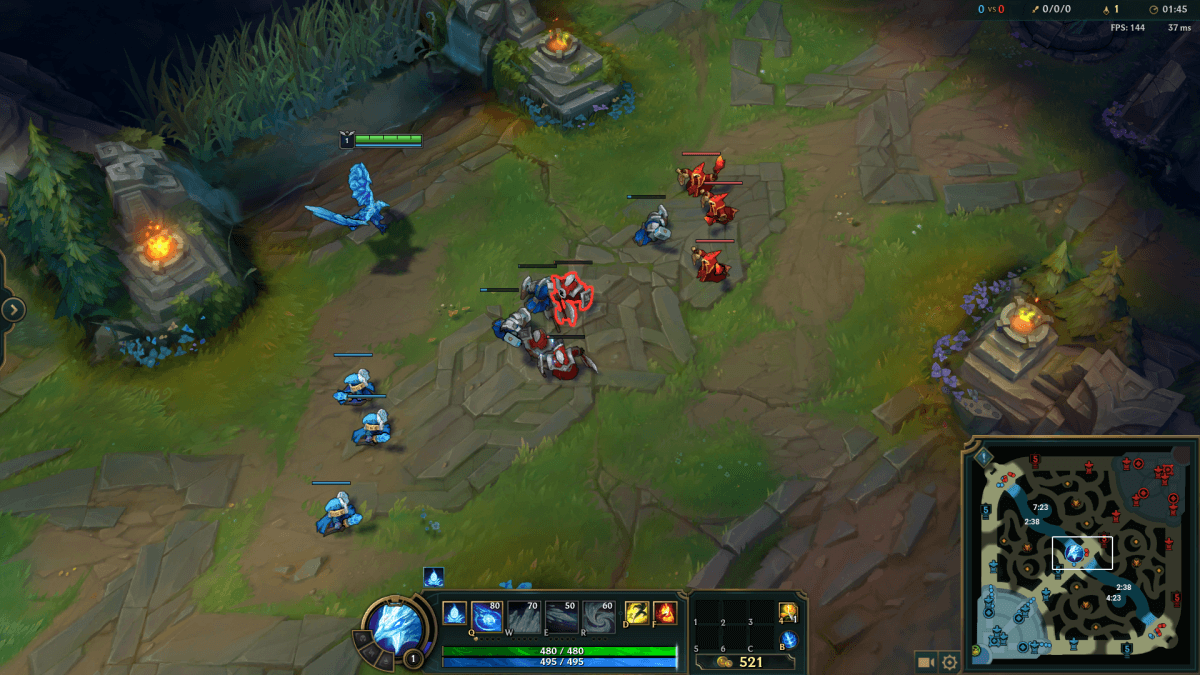
Back in my day being able to last hit with Anivia was the hallmark of the highest-skilled player.
So, a quick tip – which is especially useful for Mages, as their auto-attack damage is very low, which makes it finicky to last hit minions without experience. Don’t overlook spending 10 minutes in the practice tool just farming minions when picking up a new champ!
For example, let’s take one of the newest champion releases, Vex, the Gloomist. The most popular build for her includes taking Electrocute Keystone, and leveling her E, Looming Darkness, as the first ability as you enter the game.
Trading patterns
Directly correlated to Ability identity, basic trading patterns – for laners – is bread and butter for your ranked games. Knowing when to trade comes later – and it’s one of the most difficult tasks in this game – but knowing how is a must.
Continuing with Vex example: knowing how basic trade patterns work is as easy as reading the ability description. Starting with E allows you to utilize both the parts of Vex’s passive, Doom ‘n Gloom. Allowing you to easily CC your opponents from level one, and follow it up with an auto-attack to consume the passive mark for bonus damage.
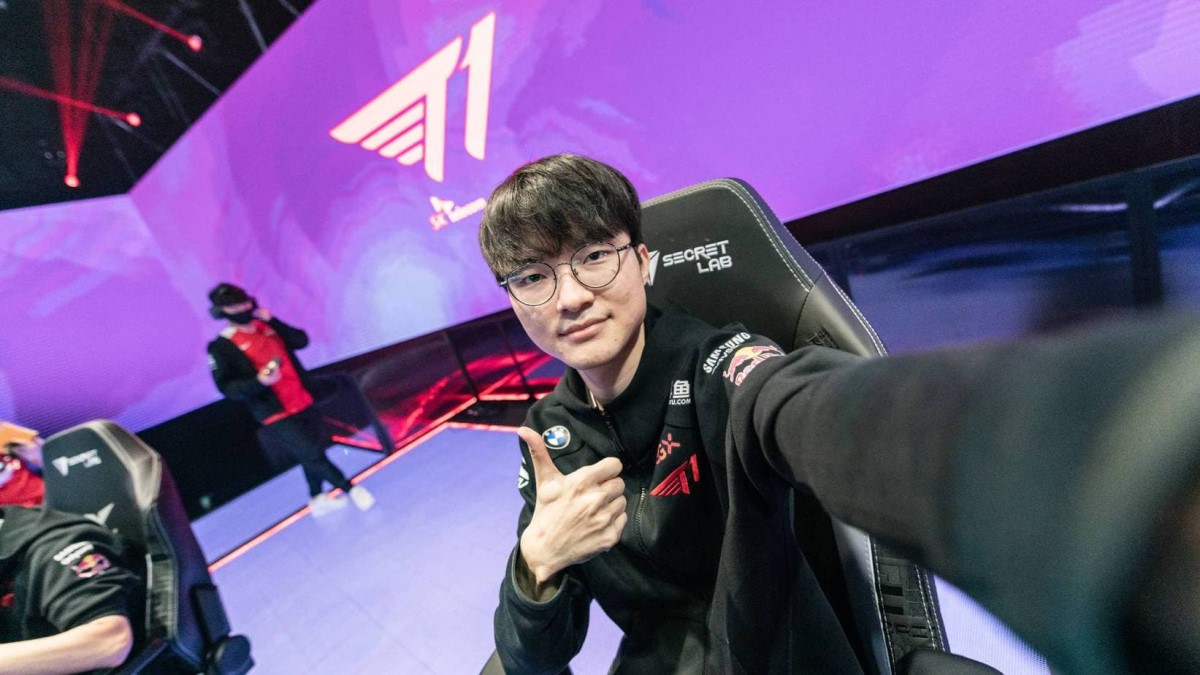
The longest-standing professional League of Legends player at the highest level, Faker is regarded as the creator of many midlane concepts that have become a gospel. Oh, and he likes Vex, too.
While “Trading pattern” might seem like the same thing as a “combo”, they’re actually quite different. While combos are, for the most part, a vacuum-type thing of what your champion is simply capable of, the trading pattern also factors in the opponent’s possible retaliation attempt. This is why, for example, as Vex, you are not looking to get a second auto-attack in for an Electrocute proc against Ranged enemy champions on level one.
Although that would let you maximize your ability damage, the payoff of letting your opponent have “their turn” to attack you back is most of the time not worth it. Against melee champions, however, feel free to do so!
Intermediate
There is an important reason to distinguish these steps to learning a champion. The path to complete mastery of a champion is long – so long, in fact, that you can’t complete it at all, only come ever close. Therefore, it’s important to compartmentalize and learn the skills step-by-step to avoid getting overwhelmed by technicalities.
The basics should take you around 20 games to learn. You probably won’t master them fully, but you’ll get a fair idea of how to perform on a decent level. Of course, that number also depends on the champion’s difficulty: while the easier champs’ (like Vex) should be learnable within 10-20 games, mechanically demanding champions like Qiyana take far longer if you wish to learn how to play them even on a basic level.
Once you’ve familiarized yourself with the champion’s basics, it’s time to focus on a level beyond.
Wave management
Although wave management is a universal skill for everyone (except for Junglers and Supports, to a lesser extent), different champions oftentimes require you to take a different approach to it. For instance, Aurelion Sol is generally interested in keeping the waves cleared right away to enable his Comet of Legend-fueled roams, but someone like Kayle is perfectly content in getting pushed in to enable her ability to safely farm under the turret.
The tricky part about this skill – and what makes it particularly hard to master – is adjusting your gameplay to the needs of a game on the fly. Even though Aurelion Sol generally shoves right away, doing so mindlessly places a big target on his head – and for a low-range, immobile mage it is often a death sentence to be caught off position.
Win conditions
Identifying win conditions and your champion’s ability to influence them makes a difference between clean and confident games and coinflips. For midlane champions, this skill often correlates with your ability to wave manage, as you occupy the most important lane when it comes to roaming.
For a champion like Twisted Fate, your main win condition will always be the ability to pull off roams with Destiny, his ultimate ability. But it’s not as easy as just clicking a button: to achieve beneficial roams, you must first shove the wave, identify a lane that would benefit the most from your help, and then avoid the enemy’s counterplay.
For other champions, the win condition is not as straightforward. To make things more complicated, the win condition may change throughout the game depending on the opponents’ gameplay pattern, the success of your lanes, and even your teammates’ mental state in addition to the draft.

Formerly a midlaner and then the head coach for team Dire Wolves, Curtis ‘Curtis’ Morgan is a phenomenal League of Legends player, placing at the very highest ranks of Challenger for 5 years in a row now. His background in professional coaching on the highest level is the reason for his content being very in-depth and educational, as well as accessible to players of all skill levels.
Previously known as Sharp during his days as the top- and midlaner for Dire Wolves, he embraced his passion for teaching, taking up the alias of CoachCurtis, and launching a prolific YouTube channel for midlane coaching – and not only! A word of caution, though – Curtis’s videos are so in-depth that you better stock up on food and supplies before opening up one of those.
Vex is a great example of this. In his latest guide, CoachCurtis explains two styles for this champion. Depending on the enemy’s and your team’s picks, Vex can play as an assassin/mage hybrid or more of a traditional control mage focused on peeling their ADC and creating space.

Knowing your win condition influences everything: the trades you should take, the way you should clear waves and roam, and the way you play out team fights are all affected by this skill. Fully mastering this skill is impossible, but it is required to learn after you get over the basics, so I’m not putting it into the “road to perfection” category.
Playing outside your lane
This skill is what I personally struggled with the most. It encompasses your ability to put all the theory of item builds, champion interactions, win conditions, etc. into a single game plan that you should follow. Without it, most games will feel like a single coin-flip game of chance where the outcome is decided not by your ability to play, but by someone’s silly mistakes.
Compared to the laning phase, midgame increases the number of interactions your champion has with the game tenfold. Tracking a singular opponent’s cooldowns while watching the minimap and managing your own is hard already on the lane, and it’s only getting harder once you get into the part where you’re moving together as a team.
Some champions’ entire identity revolves around this skill. Assassin midlaners, for instance, exist pretty much to roam and influence other lanes.
Road to mastery
Mastering the things mentioned previously is guaranteed to catapult you at least to the Masters tier. But, the skill ceiling doesn’t end there – really, it doesn’t end at all. So we keep going.
Advanced trading
You begin to learn the champion by discovering the clean, blood-less trades. You know you’ve mastered the champion when you’ve taken a trade that would leave an unknowing spectator horrified and convinced of your downfall – but you actually won it. What advanced trading means is the ability to look at the game as a game of chess, where all the resources – your HP, your mana, your wave state, your gold, yours and enemy’s jungler’s positioning, etc. are to be taken into consideration before going in.
Knowing when and where you’re supposed to play aggressively and where passively. Knowing how to play patiently and bear with losing an entire wave of minions for seemingly no reason. That’s just a drop in the bucket of what it takes to actually master the concept of advanced trading. The Chinese Qiyana one-trick player, Beifeng, is the perfect embodiment of this concept – his aggressive playstyle of expending your HP with reckless abandon can only be understood by those with deep knowledge of game state and individual champions’ strengths and weaknesses. This playstyle is not for those faint of heart!
Teamfighting
It seems kind of odd to put this skill so high up. After all, every single game has a massive, game-deciding team fight or two (or, if you’re familiar with SaltyTeemo’s stream, ten or twenty). The thing is – all these fights are mostly decided by the advantages the teams have accumulated throughout wave management, roaming, ganking, skirmishing, and so on. So, for the majority of the playerbase, a team fight is basically a giant stat check.
But if you’ve ascended high above the average, now it’s the time to decipher the chaotic nature of team fights and turn it into an orderly and clean work of art. Obviously, easier said than done – and that’s why this skill is this far up the list.
It’s tempting to put this as an example of a perfect team fight – but, some might know, it actually was not. Investing so much to eliminate a single member of the opposing team is, frankly speaking, absolutely not worth it, which was proven later in this match. But it’s so pretty to look at!
Creativity
The pinnacle of champion mastery. While it’s not uncommon for lower-ranked players to play unorthodox builds and out-of-meta champions in uncharacteristic roles, doing stuff at random is no match for a calculated approach you unlock once you’ve mastered and acknowledged all of a champion’s strengths and weaknesses.
This includes everything from a different build to going as far as taking your champion to a whole different role. Some people go a step further and even impose challenges on themselves, like this guy who one-tricked Urgot all the way to Masters from all roles! This means Urgot support, Urgot jungle, Urgot ADC, and even Urgot top!
The takeaway
With this amount of champion’s learning aspects, it’s easy to get lost and frustrated. Tacking the number of things you should be doing regardless of your pick on top of it – like tracking objectives and farming – may make the process of learning unsurmountable.
While the process does indeed take tens of hours of effort and learning, it’s also surprisingly dangerous and nuanced. For instance, certain trading and laning patterns might work just fine in Platinum, doing the same thing in Master and above may be a grave mistake. In short: learning wrong can be more dangerous than not learning at all!
With that in mind, if you’re reading this, you must be pretty dedicated to the game. And all you need to learn is dedication! And a little bit of warning about what to look out for when learning.