
Among the diverse map pool in VALORANT, Ascent holds a special place as one of the most iconic and strategically demanding battlegrounds. Designed as the first original map released by Riot Games, it blends a traditional three-lane layout with innovative mechanics like mechanical doors. This combination creates a balanced yet complex environment where success relies on planning, agent synergy, and map control. Despite its clean design, Ascent presents a consistent challenge for Attackers, making it a favorite in professional play.
Also read: Best VALORANT Betting Sites
Lore and Aesthetic
Set in a reimagined version of Venice, Ascent floats in the sky after a Radianite event fragmented the city into islands. The map’s streets reflect Italian culture: cobbled alleys, bookshops, markets, and rustic architecture. Murals and ruins add layers of history, creating both visual appeal and narrative depth. Beyond its competitive reputation, Ascent immerses players in a Venetian atmosphere that feels alive and authentic.
Map Layout and Structure
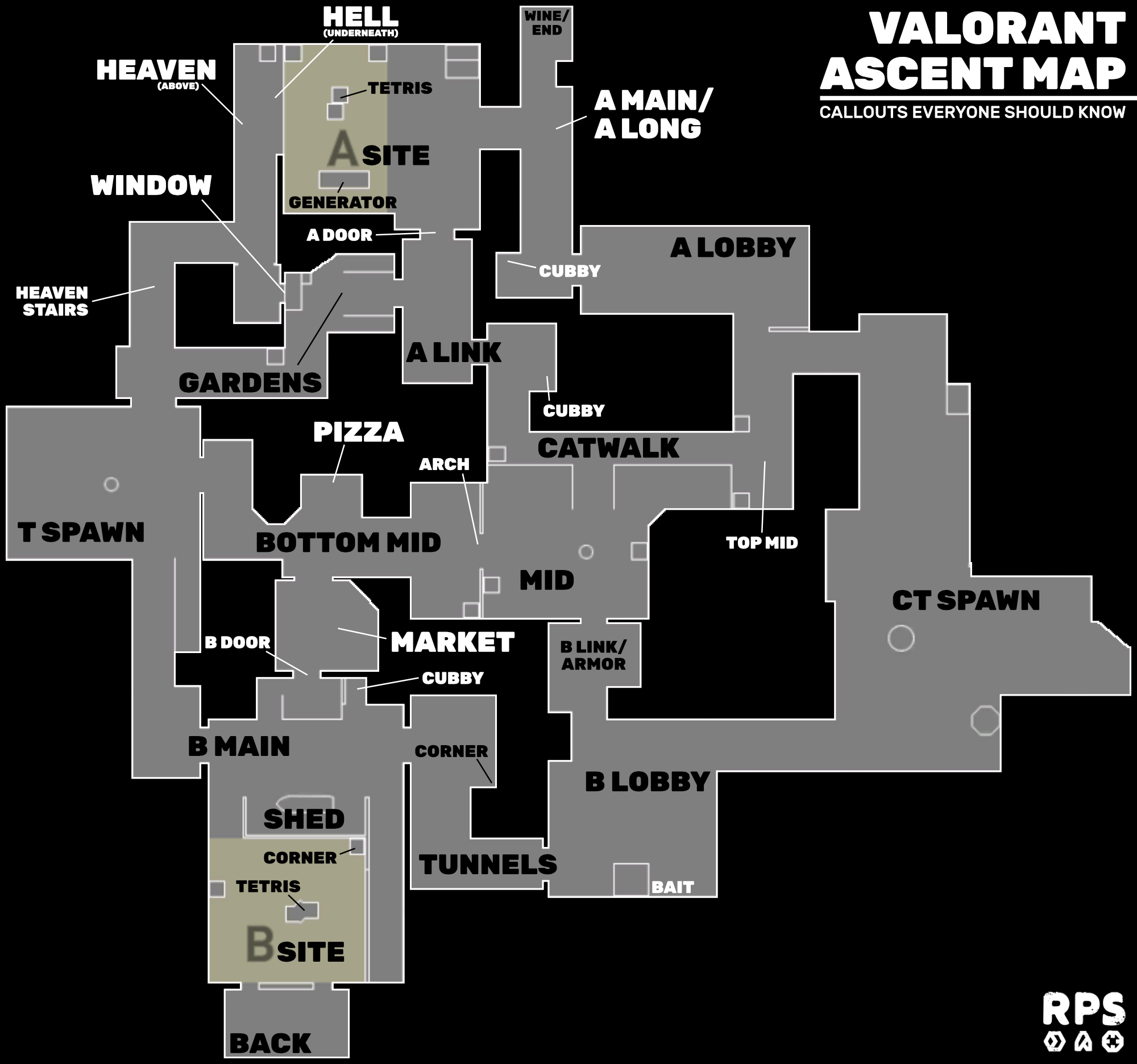
Ascent follows the classic three-lane formula familiar to tactical shooters:
- A Site: Accessible through A Main and Catwalk. The zone includes key callouts such as Wine, Generator, Heaven, and Hell. Its open angles require careful use of smokes and recon.
- B Site: Entered through B Main or Mid, with callouts like Market, Logs, and Boathouse. Tight corners make it a haven for defenders and utility-heavy fights.
- Mid: The centerpiece of Ascent. Control of Mid Arch, Catwalk, and Pizza provides rotation freedom and dictates the pace of the match.
Unique to Ascent are its mechanical doors, located at both A and B sites. Once sealed by defenders, these cannot be reopened, forcing attackers to either destroy them or reroute. This mechanic adds tactical depth, influencing post-plant defense and rotation timing.
Why Ascent Favors Defenders
- Long sightlines from spawn to sites allow operators and rifles to punish early aggression.
- Blast doors give defenders the power to limit attacker access.
- Mid choke points require significant utility investment to breach safely.
This defender advantage doesn’t make attacking impossible but instead demands layered strategy and precise execution.
Key Callouts for Communication
Clear callouts are essential for organized play. Some of the most critical include:
- A Site: A Main, Wine, Generator, Dice, Heaven, Hell.
- Mid: Courtyard, Catwalk, Pizza, Market Door, Top Mid.
- B Site: Logs, Boathouse, Market, Workshop.
Consistent vocabulary across a team ensures faster reactions and stronger coordination.
Recommended Agents for Ascent
The agent pool for Ascent highlights the importance of map control, recon, and defensive anchoring.
- Controller: Omen – His smokes cover critical chokepoints like A Heaven or Market, while his teleport provides rotation flexibility.
- Sentinel: Killjoy – A staple on Ascent. Her turret and Alarmbot dominate tight angles on B and mid, offering both intel and delay power.
- Duelist: Jett – Perfect for exploiting verticality and dashing through choke points. Jett can take risky Operator angles and escape.
- Initiator: Sova – The king of reconnaissance. His recon arrows cover Mid and A Main, revealing enemy setups and enabling coordinated site hits.

Alternative picks like KAY/O or Fade also fit well, adding disruption and layered recon respectively.
Attacking Strategies on Ascent
-
Mid Control First
Pro teams often emphasize securing mid. Gaining tiles and catwalk access allows splits into either site, stretching defenders thin. -
Utility Investment
Smokes for Heaven or Market, recon darts into choke points, and flashes through main entryways are non-negotiable. Without utility, attackers risk walking into crossfires. -
Blast Door Usage
Attackers can break the doors deliberately post-plant to deny defenders quick retake paths. Timing this destruction is crucial for slowing rotations. -
Unexpected Angles
Because of Ascent’s popularity, defenders anticipate common plays. Attackers gain an edge by mixing in unusual pushes through mid or lurking in areas like Pizza or Wine.
Defensive Strategies on Ascent
-
Anchor and Delay
Killjoy’s utility, Sage walls, or Cypher trips can stall attackers long enough for rotations. -
Operator Angles
A Heaven and Mid Arch are prime operator spots, punishing overzealous attackers. -
Rotations via Mid
Swift control of mid allows defenders to reinforce either site quickly. Overcommitting early leaves vulnerabilities, so balance is key. -
Door Control
Defenders should close doors early when pressured, forcing attackers to burn time and resources breaking them.
Insights from Professional Play
In the pro VALORANT scene, Ascent is one of the most studied maps. Teams often base their entire strategy around mid dominance, reflecting its decisive role. Analysts note that:
- Early round aggression at A Main or B Main is often used to gain info before rotating back to reinforce mid.
- Attackers who fail to control mid often resort to all-in executes, which rarely succeed against disciplined defenses.
- Flex picks like Astra or Fade occasionally shift the balance, but the Omen + Killjoy + Jett + Sova core remains dominant in high-level play.
Tips for Improving on Ascent
- Always have a plan: Ascent rewards structured, layered attacks. Improvised pushes usually fail.
- Practice lineups: Sova darts, Killjoy nanos, and Omen smokes all have popular lineups that swing rounds.
- Learn the timings: Whether it’s closing doors as defenders or breaking them post-plant, timing plays a decisive role.
- Adapt positioning: Because the map is predictable, off-angles can win duels. Try unconventional holds in Boathouse or Heaven.
Conclusion
Ascent is a technical and rewarding map that encapsulates the heart of VALORANT’s tactical shooter design. With its three-lane structure, defender-friendly angles, and unique blast doors, it challenges both attackers and defenders to think several steps ahead. Professional teams continue to showcase the depth of its strategy, while casual players find joy in its balance of simplicity and complexity.
Success on Ascent demands planning, communication, and mastery of key agents. Whether you’re climbing ranks or studying pro play, investing time in this map pays dividends. Remember: control mid, manage the doors, and coordinate every move — the Venetian sky awaits your victory.