 Frokat
Since their introduction in the years’ pre-season, the objective bounty system has been overshadowed by seemingly bigger threats to the game’s integrity. While the community focused on the new items being too strong to exist (like Crown of the Shattered Queen) or runes too impactful to be balanced (like the release Lethal Tempo), and finally on the new Chemtech Drake that seemingly choked out any hope out of the defending team with its powerful map-wide effect and Soul, Objective bounties remained fairly undiscussed.
Since that was the case, one could easily assume that it was due to their balanced state – yet that assumption couldn’t be further from the truth. Although the system’s ability to enable late-game characters to thrive was immediately noted, the real extent of its influence on the meta went mostly unnoticed. After all, it’s easier to see Yone suddenly dealing twice the damage he’s used to dealing on Level One, or a massive cloud of fog that makes everyone inside invisible, than the death by a thousand cuts caused by the new bounties.

Janna, the Storm’s Fury has been one of the unexpected winners of the Objective Bounty lottery. Popularized seemingly overnight, the new strategy of roaming toplane enchanters was addressed by Riot Games almost instantly.
Over the years, League of Legends has become known as one of the most snowbally games in the market. Holding true in both amateur and professional matches, it was not uncommon for the pro teams to play incredibly passively, making up strategies that balanced around having as little interaction with opponents as possible. Stuff like early lane swaps we have all “enjoyed” in Season Four are the pinnacle of that – with games flying by without a single kill before minute twenty.
And the reasoning for that is simple – even though League is an incredibly complex game, it becomes exponentially harder to win your advantage back once you’ve lost it. Even without mechanics like creep denying and actually losing gold from your pocket once you die, League of Legends was synonymous with “snowball”. And playing matches where you lose control of the match five minutes in but have to sit there and be a punching bag for the opposing team for the next twenty minutes is probably the worst feeling.
It wouldn’t be a stretch to call this feeling the prime reason for the game’s infamous rep as “the most toxic online game.” Turns out, feeling powerless doesn’t sit well with the majority of people. When you have nothing to do but stare at a gray screen after you’ve been oneshot by a fed enemy, hitting that enter button and starting to write not-so-pleasant things seems way too simple…
Saved or ruined?
With Riot Games’ unending quest to reduce the snowball potential of the game, increase the flashiness of professional games by making daring plays less punishing, and eliminate “toxicity” from the list of most commonly used adjectives when describing League of Legends, Objective Bounties seemed like a perfect solution to all three. However, the community seems split on the topic.
A quick note – this isn’t the first time Riot has attempted something similar. Back in 2018, we saw an introduction of a brand new Kill Bounty system, updating on the game’s original release Shutdown framework.
The previous shot at reducing the game’s passiveness was aimed mostly at the pro scene, as the Kill Bounties started taking the players’ minion kill scores into account. Still, playing passively remained the go-to way of playing for the pros.
The new Objective Bounty system seems like a logical continuation of Riot’s efforts to reduce the number of one-sided stomps. As the losing team falls behind in gold and objectives (like Dragon Soul) more and more, the rewards they receive for taking any major objective on the map increase. Seems fair, but there’s a number of caveats that got the community rumbling with discontent.
The first point against these new Bounties is straightforward – it limits available picks and forces the meta to lean more heavily on scaling, late-game oriented champions. As you pick something like Kayle, a late game powerhouse that is pathetically weak in early game, it’s only logical that you – and your team – will fall behind in gold from the start. Therefore, certain picks exploded in popularity since they get gold for pretty much existing – wave hello to Kassadin who even had to be nerfed because of his dominance and skyrocketing winrate in games that went over 30 minutes.
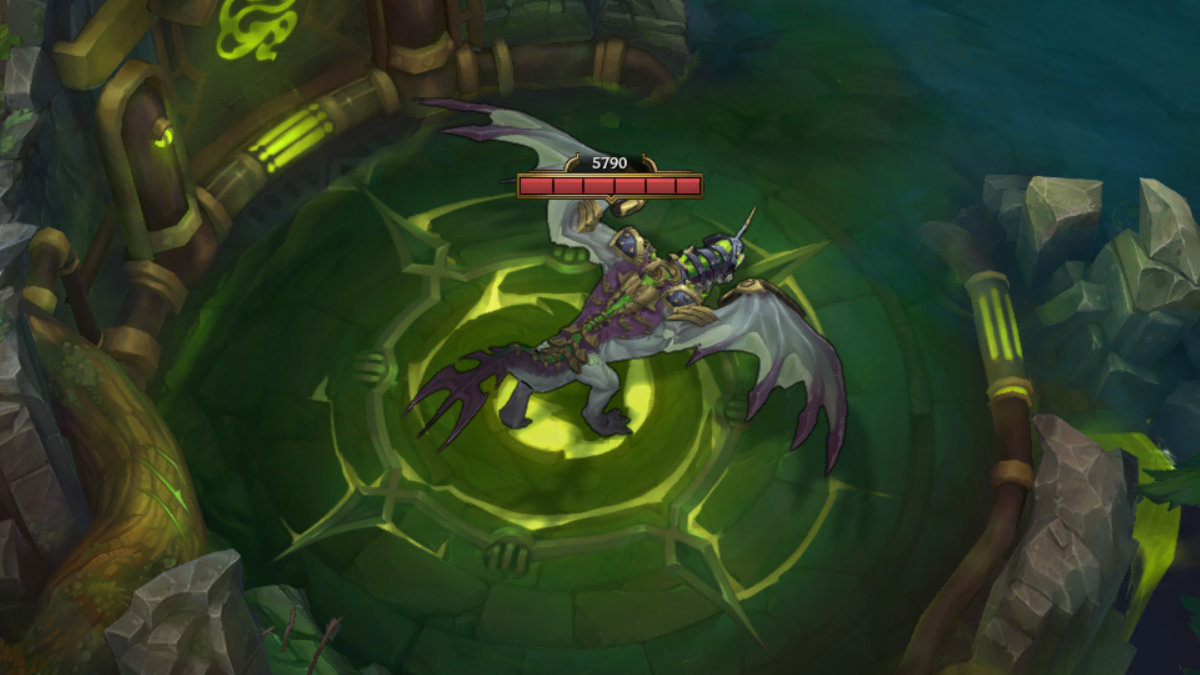
The unlucky one of the two new Drakes introduced in Season 12, the Chemtech Dragon waved goodbye to the Rift recently. Could it be that the same fate awaits Objective Bounties, as well?
The second thing that got the community to collectively scratch their heads in confusion was the nature of the Bounties itself. As they originally were believed to be – maybe because of misunderstanding, or maybe it was the fault of Riot’s intentionally vague wording – rewards for taking a single, particular objective on the map. Turns out you get gold for… everything. Which made things shift in value. For instance, trading a T2 Turret for a T1 one has always been a bad trade. With the introduction of the bounties, the same can’t be said with 100% certainty. But perhaps it’s not necessarily a bad thing – more complexity in decision-making just adds to the game’s overall skill level.
Another unforeseen consequence of the introduction of these bounties: the enchanter toplane meta. As the system takes into account the amount of gold that each lane has individually, a single solo-laner being severely down is enough to trigger it. Coupling this strategy with champions that are designed to function with low economy – like supports – rewards their team with an ungodly amount of gold straight to their carries’ pockets. The most infamous example of this has been toplane Janna – going top, taking Smite, and never even showing up on her lane has been the name of the game for that champion.
If these complaints feel too specific for you, here’s another one: the general consensus on the bounties is that they make winning punishing and games very coin-flippy.
The big T put it best here: with both Objective Bounties and Kill Bounties simultaneously, the winning team often finds themselves in a weird situation where they’re playing safely and defensively while their opponents take risks. This is a bit of a “culture shock” as the exact opposite has been true for the last 10 seasons, so most players have trouble adjusting to this mindset.
What’s next?
Even though the Objective Bounties have introduced a fair slew of issues, the underlying framework seems like a step in the right direction. “Quick stomp” has been the name of the game for seasons now, where the actual outcome of the match was heavily decided in the early game, leaving the defending team almost no chance of coming back even if their opponents were to make a severe mistake.
Given Riot’s commitment to remedying the problems that accompanied the bounties’ release, it’s fair to say that the idea is absolutely salvageable.
Patch Preview for 12.4!
Some pretty fun buffs and nerfs coming through, any champs we missed?
As an aside, we're still watching fighter items to see if they need any adjustments but there's nothing immediate there. pic.twitter.com/EqNudAiAEM
— Phlox (@RiotPhlox) February 7, 2022
The patch 12.4 will include the so-needed fixes to the roaming toplane enchanter meta, toning down on both the individual player’s gold income as well as the team-wide gold generation from Objective Bounties should multiple Support-class champions be picked.